Get Full Government Meeting Transcripts, Videos, & Alerts Forever!
Get email alerts on the Planning And Permitting Reform topic
No spam. Unsubscribe anytime.
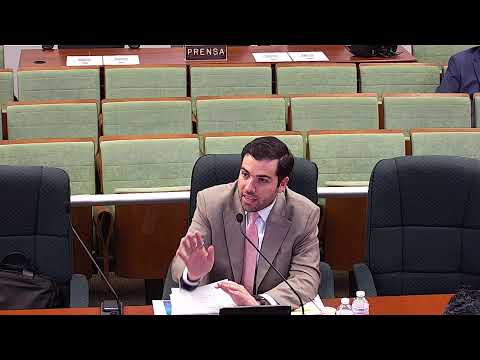
House special commission hears testimony on Bill 1213 to unify Puerto Rico's planning and permitting code
Summary
Secretary Sebastián Negrón presented House Bill 1213 to create a unified planning and permitting code; lawmakers pressed him on the bill's supremacy clause, municipal autonomy, liability for privately contracted "professionals authorized," the $2.5M digital platform, and implementation staffing and audit safeguards.
A special commission of the House of Representatives convened April 23 to take testimony on House Bill 1213, a sweeping proposal to create a single planning and permitting code for Puerto Rico. Secretary Sebastián Negrón Reicher, deponent for the Department of Economic Development and Commerce (DDEC), told members the measure seeks to streamline a fragmented system of more than 45 laws and dozens of regulations and to reduce permit timelines that he said now can stretch from nine to 18 months.
"Estoy convencido de que el PC 1213 es un proyecto de vanguardia," Negrón said in his opening remarks, arguing the code balances environmental protection with administrative agility and would reduce permitting costs that he estimated can account for 10%–30% of construction expenses.
Why it matters: Lawmakers repeatedly framed the debate in economic and democratic terms. Supporters said delays in permitting contribute to Puerto Rico's housing shortage and investment stagnation; critics warned that the bill's clause of supremacy, centralization of rulemaking and reliance on temporarily contracted professionals could erode municipal authority, weaken oversight, or transfer risk to communities.
Key elements presented
- Centralization and a unified regulation: The bill consolidates many dispersed statutes and calls for a single, unified regulation to govern permitting procedures, adoption of which the department would coordinate with affected agencies.
- New institutional architecture: The proposal creates a central Office of Permits within DDEC, specialized units for technical review, an auditor of permits and panels for fiscalization and compliance.
- "Professionals authorized": For low-risk, ministerial cases the bill allows certified private professionals to adjudicate certain permit decisions; the department proposes random audits of at least 25% of permits granted under such certification and sanctions including fines, suspension, and possible revocation of the professional's authorization.
- Digital platform and costs: Negrón said $2.5 million has been identified for immediate technology modernization and that the first-year implementation estimate is about $6.9 million (including $1.7 million additional annual payroll for 29 new positions). He said those funds are on department accounts but require fiscal-board authorization to use.
Legislators' concerns and exchanges
Lawmakers pressed the secretary on a set of recurring themes:
- Supremacy clause and municipal autonomy: Multiple members asked whether the clause that makes the code prevail over "incompatible" norms could in practice override municipal plans and delegated authorities. Negrón said the intent is legal harmonization, not to remove municipal adjudicative roles, and offered to clarify and amend language to safeguard delegation and participation of municipalities.
- Due process and administrative procedure: The bill proposes a specialized procedural regime for permitting rather than applying the general administrative procedure law. Members asked how the code will preserve public participation and remedies; Negrón pointed to longer public comment periods (75 days vs. 30) and multiple mandatory hearings as safeguards but agreed to provide written clarifications.
- Liability, conflicts of interest and oversight of private professionals: Representatives sought guarantees that privately contracted "professionals authorized" would not create conflicts of interest. The department said assigned professionals would face disclosure rules built into the digital assignment system, be subject to random audits (25% target), and required to carry liability insurance; the government would assume vicarious responsibility only for ministerial cases assigned by the office, Negrón said, and he agreed to supply statutory language clarifying limits.
- Environmental protections and technical standards: Members flagged buffer zones, definitions for coastal and riverine areas, and limits on altering intermittent streams. The secretary said the code preserves environmental safeguards and pledged to refine technical definitions and buffer distances during the amendment process.
- Federal delegations and transition risk: Lawmakers worried that centralization could jeopardize federal delegations (for example, EPA-delegated programs). Negrón said transition reports and agency consultations are required and that the bill contains provisions to keep federal programs intact where delegation requires it; he committed to follow up in writing.
What was requested
Committee members asked for specific, written follow-ups within five days, including: a breakdown of implementation costs and staffing, a list of affected federal programs and transition plans, clarifications on Article 18.01 immunity language and its scope, and precise text changes to the supremacy clause and the treatment of municipalities.
The hearing concluded at 12:50 p.m. with members thanking the secretary; no votes were taken. The commission will use the requested materials to inform subsequent drafting and possible amendments.