Get Full Government Meeting Transcripts, Videos, & Alerts Forever!
Get email alerts on the Open Space Monitoring topic
No spam. Unsubscribe anytime.
Consultant reports invasive plants, encroachments at six Southborough subdivisions; recommends deed updates and signage
Summary
Lucas Environmental presented the FY25 open space monitoring report to the Planning Board, documenting yard-waste piles, missing monuments, silt fencing, and advancing invasive-plant encroachment at six subdivisions; the consultant recommended deed research updates, owner notification, and considering signage to mark open-space boundaries.
Joe, a consultant from Lucas Environmental, presented the Town of Southborough’s FY25 open space monitoring report and described site visits made June 11, 12 and 25 covering six subdivisions, including Chestnut Meadow, Ledge Hill, Maple Street Extension, Southland Acres, Shipper Farm Estates, and Kane’s Crossing.
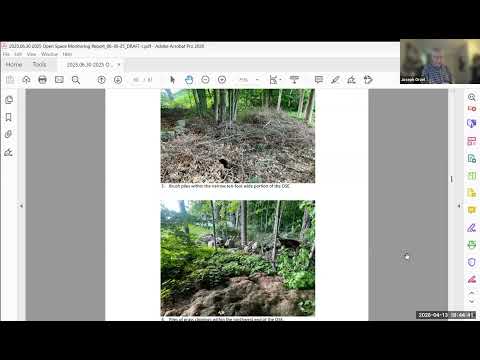
"The field monitoring inspections ... are not meant to be an exhaustive examination of the open space areas to document every ... potential issue, but to kind of give a review of the current condition of the open space," Joe said, explaining the scope and intent of the visits. He identified recurring problems: yard waste and grass-clipping piles, tree cutting or landscaping within easement areas, incomplete or missing monument bounds, persistent silt fencing, and dense invasive vegetation advancing from wood edges into fields at multiple sites.
The report singled out Chestnut Meadow for extensive silt-fence remnants and a recently installed drainage pipe; the consultant recommended removing the remaining silt fencing and stabilizing disturbed soils. At Ledge Hill the consultant noted erosion below a stormwater basin and that protective covenants did not clearly reference open-space easements, recommending monitoring and verification of covenant validity under extension requirements. Maple Street Extension and Southland Acres had yard-waste piles and evidence of vegetation clearing inconsistent with recorded restrictions; in Southland Acres the report recommended contacting lot owners because vegetation removal appears to exceed recorded limits. Shipper Farm Estates contains a mapped potential vernal pool that appeared in good condition but shows encroachments in places. Kane’s Crossing lacks a formal easement but has decision conditions restricting use; inspectors found two missing permanent markers and a large grass-clipping pile inside a conservation no-disturb area.
The consultant also reported follow-up work already done: additions to the deed-research database, uploading prior monitoring reports and draft enforcement guidelines, and identification of five or six additional sites to add in 2026. He advised verifying that common-scheme restrictions remain effective under Massachusetts General Laws — particularly MGL chapter 184, section 27, which requires re-recording in some cases for restrictions to remain in effect — and suggested the town consider both durable monuments and signs to help property owners and the public identify open-space boundaries.
Board members thanked the consultant and discussed outreach steps. One member described a planned resident letter to show property-line and open-space locations and said the aim is education ahead of enforcement. Freddy Gillespie, chair of the Open Space Preservation Commission, asked the board to seek town-counsel guidance about covenant longevity and invited closer coordination between the planning board, the conservation commission, and the Open Space Preservation Commission on invasive-species management.
The board recorded the consultant’s recommended follow-ups: notify owners where deeded restrictions exist, confirm deed language and plan notes, consider contacting owners who have cleared vegetation inconsistent with recorded restrictions, and investigate adding signage to open-space boundaries. The board signaled support for continued deed-database updates and for adding the recommended sites to the 2026 monitoring list.
The town planner and board will use the consultant’s deed-research updates and the monitoring form uploaded to the deed-research database to prioritize outreach and any enforcement or mitigation steps. The report and the consultant’s draft open-space awareness and enforcement guidelines were uploaded for the board’s reference.