Get Full Government Meeting Transcripts, Videos, & Alerts Forever!
Get email alerts on the Transportation Funding topic
No spam. Unsubscribe anytime.
North Ogden Council backs staff'recommended transportation-fee approach aimed at arresting road deterioration
Summary
After a multi-hour public hearing, the North Ogden City Council voted to recommend staff's scenario for a transportation utility fee (a resident-equivalent monthly charge with business discounts) to raise roughly $1.4 million a year to address a widening road maintenance backlog.
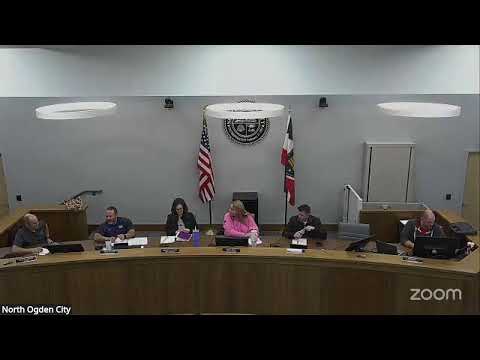
The North Ogden City Council on Jan. 13 voted to recommend staff's preferred transportation-utility fee option to raise recurring revenue for road maintenance.
City manager John Kahl and consultants from Kruse/Cruise presented findings that maintenance costs have risen substantially in recent years and that without new, dedicated revenue the city's road network will continue to deteriorate. "Without this money, our roads will continue to degrade," Kahl told the council, summarizing staff's motivation for the fee.
Consultant Marcus Keller explained the technical case: road repairs have an "exponential jump" in cost once a pavement crosses a service-life threshold, and preventive treatments are far cheaper than full reconstruction. Keller described three scenarios developed by the consultant team; staff recommended Scenario 2, which the council advanced in its vote. Keller said the Scenario 2 structure would set a roughly $15 monthly-equivalent charge for a single-family ERU, with businesses paying by estimated trip generation and receiving a large (90%) discount per ERU to avoid disproportionate bills.
Council members asked about equity protections and low-income exemptions. Dave (city staff) said the city can mirror county hardship and veteran-relief programs to identify households eligible for fee relief; "we can proactively go out and match the account and give them the discount," he said. Public commenters raised concerns about allocation equity (multi-unit billing and the effect of waivers); Sandy Cochran asked for a clear comparison of projected revenue per scenario and operational capacity; staff answered that Scenario 2 and 3 both produce about $1.4'$1.5 million annually while the city's staff can reasonably manage about $2 million a year of road work without hiring additional crew.
After discussion the council voted in favor of the staff recommendation (Scenario 2). Mayor Barker called for a roll-call, and the motion passed unanimously among members present.
Next steps: staff will prepare ordinance language and fee schedules for formal adoption and bring back implementing details on low-income exemptions and a public outreach plan describing which billing methods (bank bill-pay vs. portal card payments) will or will not require customer action.