Get Full Government Meeting Transcripts, Videos, & Alerts Forever!
Get email alerts on the Transportation topic
No spam. Unsubscribe anytime.
State transportation officials outline $48.6 million Highway 7 safety and preservation project; city presses on access and safety questions
Summary
At a Minnetrista work session on April 20, MnDOT representatives presented a Highway 7 study and the planned 2029 project, saying the $48.6 million scope includes pavement preservation, roundabouts, trail connections and signal work; city leaders raised concerns about unfunded concrete barrier recommendations, intersection access, snow‑plow maintenance and timing for additional funding.
MnDOT representatives Kyle and Matt presented the final Highway 7 study and the scope for a 2029 project to the Minnetrista City Council at a work session on April 20, 2026. The consultants described the project as a safety and pavement‑preservation effort currently scoped at $48.6 million that would cover all of segment 1 and the western portion of segment 2.
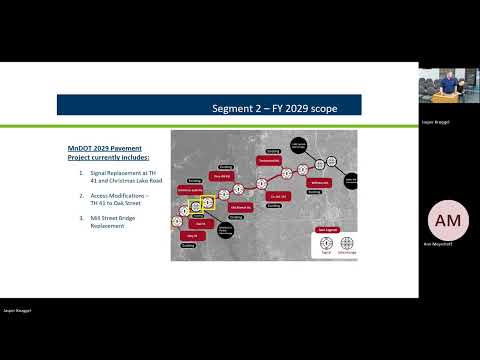
The presenters said the 2029 scope would include a mill‑and‑overlay pavement preservation across the project limits; construction of roundabouts at several intersections (including Cass/92, intersection 13 and Minowa Parkway); a 3/4 intersection at Eureka; some trail connections to the Lake Minnetonka Regional Trail; signal replacements at Highway 41 and Christmas Lake Road on the segment 2 portion in the 2029 scope; access modifications between 41 and Oak Street; and a Mill Street bridge replacement. "The concrete barrier is a safety option for those needs," Kyle said, noting the barrier remained in the study’s recommendations but is not funded for 2029.
Council members focused questions on where roundabouts are proposed and whether some designs could be shifted. Mayor Lisa Whan and Councilmember Kathleen Refkin asked why a roundabout is recommended at Cass/92 rather than closer to Wildwood and Hunter’s Crest, where Refkin said crash history and new development could concentrate turning conflicts. MnDOT said relocating intersections or changing the 2029 scope is possible to study but not currently funded: "It's something we can take back and look at," Matt said.
Funding shortfalls and prioritization were a central theme. Presenters and council members discussed a roughly $11 million gap being pursued by local advocates (the Transportation Management Organization), with potential funding requests targeted at Christmas Lake Road and Wildwood. MnDOT noted a single‑lane roundabout typically costs in the low millions, while multi‑lane roundabouts and grade separations cost substantially more, and that limited funding requires trade‑offs across many intersections on the corridor.
Operational and construction issues came up in the discussion. Council members and MnDOT staff described staging tradeoffs — completing many intersections at once versus phasing work to reduce immediate traffic disruption — and the special challenges of detours in a landscape with many lakes, wetlands and limited parallel roads. MnDOT said preliminary design starts this spring and runs into next summer, and that any additional funding to alter the 2029 scope should be identified by late summer or fall to be incorporated into design.
Council also raised recurring maintenance problems: residents west of Highway 41 have reported long delays in snow clearing. MnDOT staff said maintenance district boundaries do not always match municipal borders and offered to investigate which maintenance station covers the affected area and follow up with the city.
The presentation covered longer‑range options beyond the 2029 project, including multi‑lane roundabouts and grade separations farther east on the corridor; MnDOT said those are part of the study recommendations but require separate programming and funding.
MnDOT said it has hired a consultant to lead additional public engagement and that the final study is posted online. Officials reiterated the project timeline constraints: major elements and additional funding ideally need to be identified roughly two years before construction so design and contractor selection can proceed on schedule.
Next steps: MnDOT will continue preliminary design, pursue public engagement and follow up on specific maintenance and funding questions raised by Minnetrista. City staff and council members said they will continue to liaise with MnDOT, the local TMO and legislators regarding funding and project priorities.