Get Full Government Meeting Transcripts, Videos, & Alerts Forever!
Get email alerts on the Health Insurance topic
No spam. Unsubscribe anytime.
District faces 38.3% health insurance premium increase; trustees weigh options to protect budgets
Summary
Representatives from the district—enefits vendor told the Superior School District board that Medicica—laims deficits would drive a 38.3% premium increase for 2026—overing costs rising from roughly $5.5 million to $7.6 million, and presented options including higher member deductibles, an HRA buy-down, or seeking other carriers.
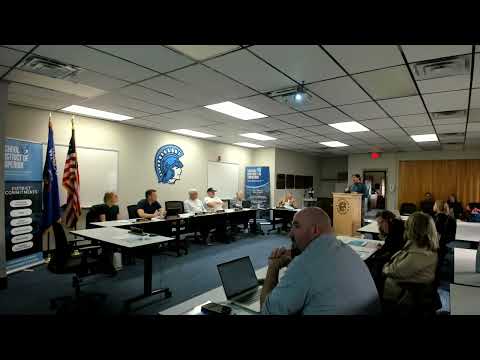
Representatives from the district—enefits consultant reported to the Superior School District Board of Education on April 20 that the district—aces a proposed 38.3% increase in health insurance premiums for the 2026—enefit year.
"What we're looking at is unfortunately a 38.3% increase in premiums," the consultant said during a presentation that traced how a narrow-network offering from Medicica produced an unexpectedly high claims experience (a roughly $200,000 deficit in 2024 and an estimated $2.3 million deficit in 2025). The consultants told the board the shortfall resulted from several factors: an initially lower-than-market premium when Medicica entered the group, a prior year rate cap that limited adjustment, and an unusually high claims year.
The presentation showed the district's current annual premium spend at about $5.5 million and projected renewal with Medicica at approximately $7.6 million. Consultants also shared several actuarial and marketplace analyses that suggested an even larger adjustment would be required under different measurement methods: a carrier group experience metric that would imply a 79% increase and a community-adjusted figure near 55%.
Consultant Jen summarized key cost drivers: elevated emergency-room utilization (87 of 185 ER visits deemed non-emergent in the review), high utilization of specialty pharmacy (estimated at 68% of the district's pharmacy spend), and 31 recent high-cost medical claims (over $50,000 each), of which 28 remained active. "A third of the renewal premiums is set to go towards these things that already exist," she said.
Board members asked for options and clarifications. The consultants described three pragmatic levers the district could consider to reduce the immediate increase: raising members' out-of-pocket limits, introducing an HRA buy-down structure, or changing carriers. Under illustrative calculations presented to the board, increasing the single deductible from $3,400 to $4,000 would reduce the renewal increase to about 34.1%; an HRA-style buy-down with an $8,500 base deductible was projected by actuaries to still leave the district roughly 36.4% above current costs, with notable risk that actual costs could be higher than modeled. The consultants said they solicited proposals from six fully insured carriers; five declined to quote or submitted non-competitive proposals, and UnitedHealthcare provided an illustrative, but not fully developed, quote.
Board members and consultants also discussed member education and utilization management as medium-term mitigations. The consultants recommended layered communications to promote virtual care, nurse triage lines and alternative sites of service, and prior-authorization or utilization controls for expensive specialty drugs. "We can help with education and give members options so they don't default to the ER," the presenter said.
Administrators warned of the budgetary impact. One board member noted that an additional $1.8 million district expense would shift their projected surplus into a deficit for next year's budget. Presenters and trustees said they had already raised the problem with regional legislators and asked for a statewide solution to rapid health-cost inflation.
Next steps: the board moved the budget and insurance item earlier in the agenda to allow more time for discussion; administrators and the benefits consultant said they would continue to market the group, refine quotes, provide a final recommendation to the board and return with options that include projected dollar impacts on the general fund. No formal premium change was adopted at the meeting.
Provenance: Presentation and discussion (consultant remarks, market quotes, and Q&A) were recorded in the meeting transcript between SEG 877 and SEG 1360, with detailed figures and recommendations articulated in SEG 963 nd SEG 1268 nd related discussion through SEG 1468.