Get Full Government Meeting Transcripts, Videos, & Alerts Forever!
Get email alerts on the Enforcement Process topic
No spam. Unsubscribe anytime.
Carroll County to shift nuisance enforcement toward local code board; county attorney details citations, hearings and appeals
Summary
County Attorney Nick Marsh described a proposed enforcement pathway that replaces routine criminal filings with a notice/citation system heard by a local code enforcement board; penalties, lien authority and appeals to Circuit Court remain available, and officials said the Kentucky Right to Farm statute limits actions against legitimate agricultural operations.
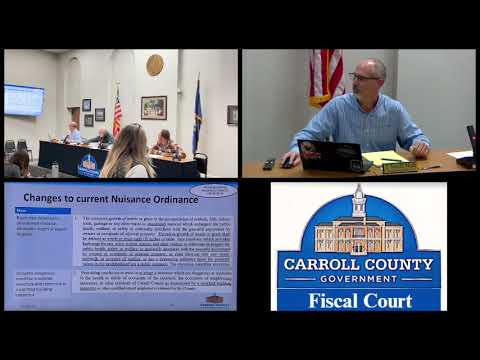
Nick Marsh, Carroll County attorney, told participants the county’s current response to nuisance complaints typically involves a criminal complaint filed in district court and noted drawbacks: fines imposed in district court go to the state general fund and the process can be administratively burdensome.
Under the proposed program, the code enforcement officer would investigate complaints and issue a notice of violation with a period to remedy the condition. If the offender fails to comply, the county would issue a citation; recipients could pay the fine and correct the problem or request a hearing before the local code enforcement board.
Marsh said the board would be empowered to issue judgments by default if an offender fails to request or attend a hearing. If the offender requests a hearing, the board would schedule it at least seven days out; hearings will be less formal than court proceedings but taped with sworn testimony and due-process protections. The board may accept, modify or dismiss the officer’s recommendation and has discretion to reduce or forgive fines when appropriate.
"A complaint is initiated by anybody — a member of the public, law enforcement or the code enforcement officer — and the code enforcement officer will investigate the complaint," Marsh said. He described the new approach as shifting local control: civil penalties assessed by the local board would return to county funds rather than to the state's general fund, and enforcement would be handled closer to the community level.
Marsh reiterated limits on the county’s authority: the Kentucky "right to farm" protections prevent nuisance findings for practices that are a natural outgrowth of legitimate farming operations. He said staff and the board will consult state statutes when agricultural matters arise.
On remedies, Marsh described a typical enforcement path after a final board ruling: the county may place a lien on the subject property for unpaid fines and, if necessary, pursue judgment collection or foreclosure through the courts; those remedies would follow applicable state statutes and normal judicial procedures. He also said anyone dissatisfied with the board’s final ruling can file an appeal in Circuit Court within 30 days.
Presenters repeatedly said the county will coordinate with law enforcement and state agencies when complaints implicate criminal conduct, health hazards or environmental concerns, and that the proposed code enforcement process aims to keep routine nuisance matters in a local, civil forum while preserving legal safeguards and options for more serious cases.