Get Full Government Meeting Transcripts, Videos, & Alerts Forever!
Get email alerts on the Postsecondary Planning topic
No spam. Unsubscribe anytime.
Task force adds 10th-grade planning meeting to graduation plan, rejects mandatory capstone
Summary
A state task force voting on high-school graduation proposals approved adding a 10th-grade postsecondary planning meeting and declined to make a capstone project a universal graduation requirement, while leaving detailed implementation guidance and equity safeguards for later work.
A task force reviewing proposed changes to high-school graduation requirements voted to add a 10th-grade postsecondary planning meeting and decided not to require a universal senior capstone project, saying implementation and equity concerns remain unresolved.
The task force debated proposals from AIE (the Office of the State Superintendent’s analytic team, referred to repeatedly in the meeting as "Aussie"/AIE) that would require each student to develop a postsecondary plan and complete multiple postsecondary planning "touch points." Members approved a modification to add a 10th-grade meeting so students would have annual conversations beginning in 9th grade.
Representative Thompson, who chaired the meeting, told members the goal was to ‘‘put forth as much as we can of where we stand on the various proposals’’ and to collect dissenting views for a report that will accompany the task force recommendations to the state board and the public meeting. Several members argued the term "touch point" should be clarified as a substantive meeting or conversation rather than a software checkbox and asked that advisers be defined (counselors, CTE staff, teachers or administrators).
Supporters said annual, structured planning would help students, particularly those with limited access to advising. Representative Johnson Law and several members urged annual meetings and suggested distinct middle/early-year, midpoint and end-of-year check-ins so planning is iterative rather than a single annual event.
On the capstone proposal — which some members had suggested should be optional or endorsed rather than required — presenters and members emphasized staff workload and unequal resource availability across LEAs. Kathy Christie said making a capstone mandatory could become a ‘‘requirement of the student but not the school’’ if no staffing or financial supports were provided. Multiple members recommended AIE develop guidance, supports and incentives for schools that adopt capstone work rather than mandating it for all students.
The task force recorded a formal vote on the postsecondary planning modification (adding 10th grade) and approved it; members then voted not to recommend a mandatory capstone requirement, instead favoring optional or credit-bearing course models and offering capstone as an endorsement or local offering.
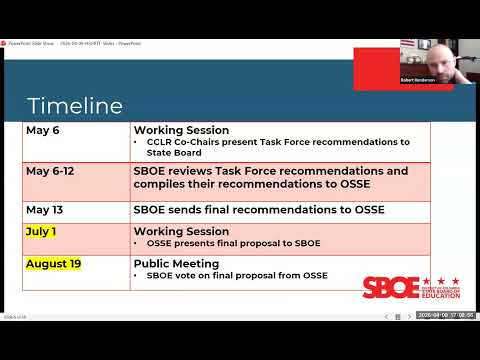
What happens next: the task force will refine implementation language (who qualifies as an adviser, how touch points are documented and how equity will be enforced) ahead of a public state board meeting. The facilitators said votes today are preliminary and that public testimony may prompt revisions before final recommendations are delivered to the state board.
Speakers quoted in this article are drawn from the task force meeting transcript.