Get Full Government Meeting Transcripts, Videos, & Alerts Forever!
Get email alerts on the Agriculture Building Exemptions topic
No spam. Unsubscribe anytime.
Committee approves bill clarifying when agricultural buildings need Montgomery County permits
Summary
The Montgomery County Economic Development Committee unanimously approved Bill 7-26 to define 'agricultural purpose' in the county building code and clarify when structures used for farming and agritourism must obtain permits, resolving ambiguity around dual-use sites such as tasting rooms and production areas.
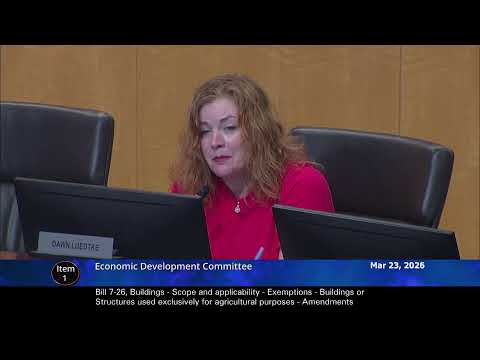
The Economic Development Committee voted unanimously March 23 to approve Bill 7-26, a short county code amendment intended to clarify when buildings used for agricultural purposes are exempt from Montgomery County building-permit requirements.
Council staff described the measure as “a fairly narrow bill that clarifies the interpretation and enforcement” of Chapter 8 of the county code, adding a definition of “agricultural purpose” to mirror related zoning and easement language. The bill was introduced Feb. 10, 2026, and received a public hearing March 10; impact statements submitted to the committee said there is no fiscal or climate impact and that the change should have a positive economic effect by reducing unnecessary fees and permitting burdens.
The text adds a definition intended to cover ordinary farming activities and the processing of agricultural products to prepare them for market, and it removes a confusing cross-reference to conditional uses that staff said could create a “lawyer’s dream” of ambiguous exemptions. A staff-proposed technical amendment stipulates that structures where customers consume food or beverages remain subject to Chapter 8 unless they already qualify for an exemption under Maryland Code, Public Safety Article §12-508.
County permitting staff and other directors present told the committee they support the clarification. “We are in favor of this,” said Mike Shovel, who identified himself as a director during the session. Staff said the Department of Permitting Services will continue case-by-case reviews when an application raises questions about primary use, separation features such as fire walls, or occupancy thresholds.
Council Vice President Marilyn Balcombe pressed staff on buildings with dual uses — for example, a production area alongside a tasting room — asking whether the bill would allow production-side renovations without triggering permitting for the consumption side. Staff responded that the department typically evaluates primary versus accessory uses based on building design, separations and egress; where an operation can show physical separations that protect safety and egress, the production area is likely to remain exempt while expansions of public-consumption areas could require permits.
A staff example discussed at the meeting described a local production facility where the agricultural production side was treated as exempt and a separate tasting area’s expansion would have required a permit. Dr. Samir Khan, invited to speak by the committee, said that the council’s interpretation — including allowing residents who live on farms to retain exemptions — is consistent with how those cases are applied in practice, while noting that novel or innovative agricultural techniques may require case-by-case review.
The committee recorded the motion to approve Bill 7-26, which was moved and seconded on the record and passed unanimously; the chair said the legislation will proceed to the full council. The committee did not record individual roll-call votes in the transcript; staff noted there were fewer than a dozen recent permit applications that would have been affected by the clarified definition.
The bill seeks to remove ambiguity for property owners and permitting staff while preserving state exemptions for narrow agritourism structures under Maryland Code §12-508. It will next be considered in full council session.