Get Full Government Meeting Transcripts, Videos, & Alerts Forever!
Get email alerts on the Housing topic
No spam. Unsubscribe anytime.
Select Board affirms HAB recommendation to fund BCDC renovation at 154–156 Boilston St., with conditions
Summary
The Select Board affirmed the Housing Advisory Board’s conditional recommendation to award $822,764 in housing trust funds to the Brookline Community Development Corporation for renovation of a six‑unit building at 154–156 Boilston Street; the funding is subject to conditions including a structural report on solar installation and insurance coverage for the roof.
The Select Board affirmed March 10 the Housing Advisory Board’s (HAB) recommendation to provide $822,764 from the town’s Affordable Housing Trust to support renovation and preservation work at 154–156 Boilston Street, a six‑unit property owned by the Brookline Community Development Corporation (BCDC).
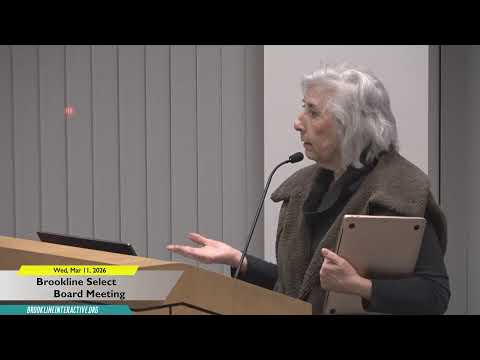
David Cavell, interim executive director of BCDC, told the Board that during renovation crews uncovered significant termite damage once walls were opened to install insulation and climate‑friendly upgrades (heat pumps, insulation and window work tied to a deep energy retrofit). The discovery increased the scope and cost of preservation work already underway; Cavell and HAB members briefed the Board on the project’s funding stack, which includes Community Preservation Act (CPA) funds (about $1.1–1.2M committed), American Rescue Plan funds and other sources. Roger Blood (HAB) explained that the total rehabilitation cost exceeds $2 million and that because the project is a preservation effort underway rather than a new construction that would yield different leverage, the town’s local subsidy worked out to roughly $400,000 per unit for the six preserved units.
Select Board members raised policy questions about per‑unit subsidies and alternatives — including whether the same funds spent differently could yield more new units of affordable housing — but several members emphasized the urgency of preserving existing units occupied by 23 residents, including seniors and children. John Vancoyak asked for clarity on total project cost and sources; Cavell said exact line‑by‑line numbers would be provided to the Board and staff.
The HAB recommendation carried conditions: (1) a satisfactory written structural engineer’s report on the solar installation for the roof, (2) investigation of insurance for the roof as a result of the solar installation and (3) delegated staff approvals and deferral of an overhead fee until project completion. After discussion the Chair included this item in the omnibus motion to take items 6B–6P; the Board voted in the omnibus to approve items 6B–6P, which included the HAB funding affirmation, with the HAB conditions attached.
Provenance: Discussion, question and answer with BCDC/ HAB (SEG 689–891; SEG 970–1020; SEG 1156–1188); roll call and omnibus vote (SEG 1258–1269).