Get Full Government Meeting Transcripts, Videos, & Alerts Forever!
Get email alerts on the Immigration Enforcement topic
No spam. Unsubscribe anytime.
Governor Lamont signs Senate Bill 397 to limit certain federal immigration-enforcement tactics in sensitive locations
Summary
Governor Ned Lamont signed Senate Bill 397, a Connecticut law that restricts certain federal immigration-enforcement practices in schools, hospitals, places of worship and other sensitive locations, requires identification for federal agents in some circumstances, and authorizes civil remedies; supporters said it defends constitutional rights while attorneys anticipate legal challenges.
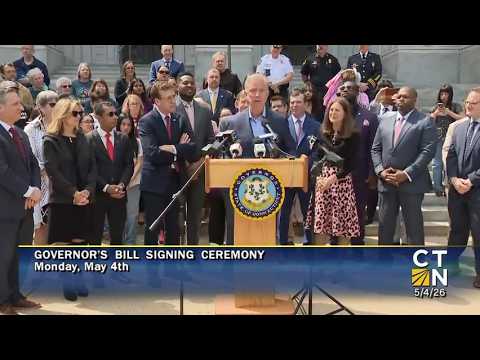
Connecticut Governor Ned Lamont signed Senate Bill 397 into law on the Statehouse steps, declaring that "we didn't waste any time" in making the protections effective and saying the state will stand up for residents regardless of where they were born.
The law, described repeatedly at the ceremony by legislative leaders as a defense of state police powers and the 10th Amendment, aims to limit intrusive federal immigration-enforcement operations in designated "sensitive locations" such as schools, hospitals and places of worship. Senator Martin Looney, president of the Connecticut Senate, said the measure "is the state of Connecticut's defense of principles of federalism and the 10th Amendment to the U.S. Constitution," and emphasized that the bill holds federal agents to the same standards the state requires of its own law-enforcement officers.
Supporters framed the statute as both practical and symbolic. Senator Bob Duff, the Senate majority leader, said he believes it is "the strongest law in the country" and described provisions intended to ensure federal agents properly identify themselves. U.S. Senator Richard Blumenthal called Connecticut a model for other states and urged federal lawmakers to adopt similar protections nationally.
Attorney General William Tong, who pledged to defend the law in court, told the crowd the measure "may be challenged and when it is, if it is, I will be waiting and Connecticut will win." Tong framed the statute as an exercise of Connecticut's longstanding police powers to keep people safe while remaining compliant with federal law.
Speakers at the event recounted examples that supporters say motivated the measure, including accounts of students and community members detained during immigration actions. State Representative Steve Stafer said the bill is a "measured constitutionally grounded response" to what he described as a nationwide campaign of fear since May 2025. At the signing, student and labor advocates — including Stephanie Dus of SEIU 1199 New England and Melanie Yunga of Connecticut Students for a Dream — described how the law will protect workers, students and families who they said were living in fear.
The signing was ceremonial but final: officials completed the pen ceremony on the steps of the Capitol and announced the bill as law. Officials acknowledged the likelihood of legal challenges; Illinois and other states with similar statutes have faced court cases, and speakers at the event said Connecticut is prepared to defend the statute in the courts.
In post-signing media remarks, officials addressed enforcement questions raised by reporters, including how the state will handle incidents involving federal agents who do not display identification. Governor Lamont said the state will work "in strong association with our police" and reiterated that accountability and identification are core elements of the new law.
What happens next: the attorney general's office said it will be prepared to defend the statute if litigated. Supporters said they expect other states to watch Connecticut's experience closely; opponents have signaled they will mount legal challenges, meaning the law's limits and practical enforcement will be decided in future court proceedings.