Get Full Government Meeting Transcripts, Videos, & Alerts Forever!
Get email alerts on the Capitol Security topic
No spam. Unsubscribe anytime.
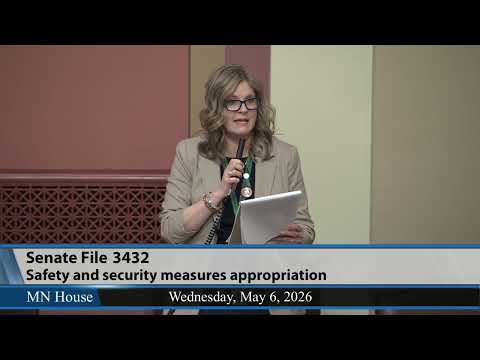
House approves $44 million Capitol and courthouse security package after tense floor fight over school safety
Summary
The Minnesota House passed Senate File 3432 on Wednesday after heated debate over whether security funding for the Capitol complex and courthouses should take precedence over additional school‑safety spending. The bill passed as amended, 92–42.
The Minnesota House on Wednesday approved a multipronged public‑safety package that provides funding for courthouse security grants, Capitol‑complex screening and hardware, short‑term security assistance for legislators facing credible threats, and additional criminal intelligence analysts at the Bureau of Criminal Apprehension. The chamber passed the bill as amended, 92–42.
Representative Paul Mueller, the floor author, told colleagues the bill is “crucial to public safety” and urged support for provisions meant to protect judges, public visitors to courthouses and the Capitol grounds and to improve statewide threat assessment. “If judges and elected officials are not safe from violence, then our democracy ceases to exist,” Mueller said as he outlined funding for courthouse grants, Capitol screening hardware and BCA investigators.
Opponents concentrated their criticism on the bill’s timing and spending priorities. Representative Representative Schultz offered an amendment (A3) that would have removed the bill’s appropriations; proponents of that approach argued school safety and student protections should be handled before making a major investment in Capitol infrastructure. “We should be putting kids first,” several lawmakers said during the floor debate, urging the House to advance a standalone school‑safety package before this measure.
Members also spent time disputing how security at the Capitol has been implemented over the past months, with some lawmakers saying new screening and restricted access have made the building harder for constituents to reach, and others responding that standardized protocols and funding are necessary after a surge of reported threats. Representative Heather Green, speaking in support of the bill, cited BCA and State Patrol data showing an increase in threats investigated this year and urged passage to maintain capacity to respond.
The House adopted several amendments in committee and on the floor before final passage. The bill as adopted keeps a mix of immediate resources for courthouse hardening, limited screening at the Capitol during the interim and next session, reimbursement language for State Patrol deficiency costs, and new funds for BCA threat analysts with statewide investigative authority.
The author and supporters said some items—such as local courthouse grants—are aimed at rural jurisdictions as well as urban centers. Opponents pointed to the bill’s multiyear price tag (discussed on the floor as roughly $44 million over four years for the Capitol program) and said the timing, ahead of a companion school‑safety package, was politically and practically problematic.
The House agreed to the final version of Senate File 3432 after multiple roll calls and procedural appeals. The bill now moves to the next step in the legislative process.