Get Full Government Meeting Transcripts, Videos, & Alerts Forever!
Get email alerts on the Transportation Ev Infrastructure topic
No spam. Unsubscribe anytime.
Tri-County planners recommend targeting NEVI community charging to fill gaps and prioritize residential access
Summary
Regional planners proposed prioritizing NEVI community charging investments to expand access in low-adoption and densely parked neighborhoods, favoring rest stops, apartment complexes and on-street charging where residents lack private parking. Staff will present recommendations to the HATS body in April and support outreach for applications this summer/fall.
Tri-County planning staff recommended focusing Pennsylvania’s NEVI community charging resources on places that currently lack chargers and on development types where residents lack private parking, rather than concentrating funding where chargers already exist.
At a March work session, Andrew Bombberger, executive director of Tri County, said staff combined public outreach and GIS analysis to produce a set of priority communities and use cases they will present to the HATS body in April. “We want to focus more on filling gaps, expanding access,” Bombberger said, summarizing the rationale for prioritizing locations with low charger access and residential parking constraints.
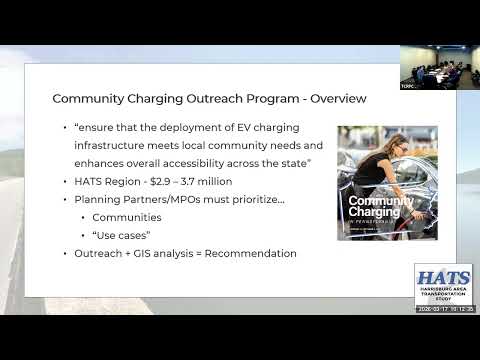
Why it matters: PennDOT’s NEVI program, created under the Infrastructure Investment and Jobs Act (also called the Bipartisan Infrastructure Law), provided Pennsylvania roughly $171 million in formula funds for electric vehicle infrastructure. After PennDOT obtained FHWA certification for its highway alternative fuel corridors, planning partners qualified to allocate a regional share of community charging funds. Tri-County staff said their regional allocation guidance is approximately $2.9–$3.7 million, though PennDOT keeps the final award amounts flexible based on applications.
What the staff found: Outreach included an online mapping tool, a recorded November webinar and a public survey (Nov–Feb) that drew about 84 responses. Survey respondents ranked use cases from a PennDOT-provided list; staff mapped roughly 79 survey points and layered them with EV registration and charger inventories. Staff reported about 6,600 EV registrations regionwide (with the largest counts in Cumberland County, then Dauphin County, and lower counts in Perry County) and 132 existing public chargers across the region.
How priorities were set: The team combined the survey ranking with GIS results to elevate use cases and places that would extend access into low-adoption or low-charger areas and where residential parking limits home charging. As a result staff reordered the top six use cases to prioritize: rest stops (for corridor coverage), apartment complexes, destination charging, on-street downtown charging, public parking in cities, and shopping centers. Dense residential neighborhoods were added as a priority because street or common-area parking limits at-home charging.
Recommended priority communities: Staff identified several communities for regional prioritization and bonus-point guidance to applicants: Steelton and Harrisburg City (noted as disadvantaged communities with high proportions of on-street parking), Rutherford, Mechanicsburg Borough, Newport Borough, a Middletown Road corridor area, and Wormleysburg (appearing in materials as 'Wordsville' in the transcript). Bombberger emphasized these designations are broad priorities for competitive scoring and do not site specific chargers.
Equity and application mechanics: Committee members asked whether prioritizing disadvantaged communities makes sense where EV ownership is currently low. Staff said the program is a competitive grant process (to which municipalities and private applicants may apply) and that prioritization is intended to encourage applications from places with access barriers. Staff also noted Department of Energy data cited in the meeting that roughly 80% of EV charging occurs at home, which informed the emphasis on places where home charging is impractical.
Concerns raised: Participants flagged operational details and safety considerations. One participant noted that some public chargers require account setup or proprietary apps and can be difficult to use; another raised safety concerns about locating chargers in secluded areas and the potential unintended consequence of removing parking for nearby businesses.
Next steps: Staff will present the recommended priorities to the HATS body in April, provide the meeting maps requested by members, and prepare for the PennDOT application round expected to open later in the summer or fall. Bombberger said staff will support outreach and application assistance to encourage submissions from municipalities and local partners in prioritized areas.
Quoted on the record: “We want to focus more on filling gaps, expanding access,” said Andrew Bombberger, Tri County’s executive director. Rebecca Winshaw, Tri County transportation planner, described the outreach and mapping tools used for the analysis. A member of the group asked for follow-up maps and staff said they would distribute the priority-location slides and the interactive mapping link.
What was not decided: No formal motions or votes were taken at the work session; staff asked only for direction and consensus before presenting the recommendations to HATS for formal action.