Get Full Government Meeting Transcripts, Videos, & Alerts Forever!
Get email alerts on the Budget topic
No spam. Unsubscribe anytime.
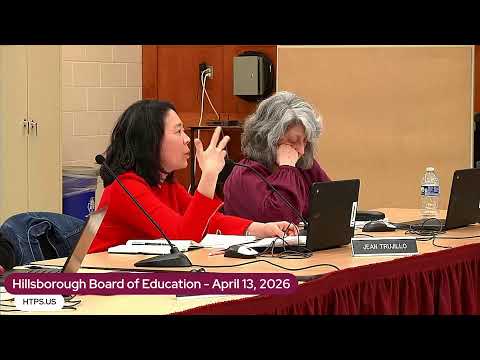
Hillsborough board reopens debate over 2% proposed tax levy ahead of April 30 final vote
Summary
Board members and residents pressed for alternatives to a proposed 2% tax levy during an April 13 meeting; President David (Mr. Davis) said he regretted voting for the levy and urged discussion of 0% or 1% options before the April 30 final budget vote.
Board President Mr. Davis said he regretted his vote to approve the proposed 2% tax levy and urged the Hillsborough Township Board of Education to use the time before the April 30 final vote to consider alternatives.
"I regret my vote to approve the 2% levy suggested in the proposed budget," Mr. Davis said in a prepared personal statement, adding that he believed the board should re-examine the levy and the items that drive it.
The public hearing that began on April 13 drew several residents who described rising tax bills as a financial burden. Thomas Zebelli told the board, "enough is enough," asking that members reconsider the tentative budget and explore a referendum or more engagement with state legislators to ease the local tax impact.
Administration and board members reviewed specific line items that could be adjusted if the board sought to lower the levy. Mr. Davis and business officials cited examples that are currently budgeted as new or nonrecurring investments: proposals for K–6 literacy and math supervisors, seven kindergarten teachers (reduced from an earlier 12), additional building monitors, an autism teacher and two aides, expanded lunch aide coverage, security upgrades including automated license-plate readers and upgraded cameras, and a proposed transportation and maintenance facility estimated at about $7 million.
Board members emphasized different priorities. Ms. Nurse said the board's duty is to students and staff, arguing that some investments — safety measures, special-education staffing and supervisors to support teachers — represent essential support. "I am a board of education representative. My duty is to make the schools as best as they can be," she said.
Other members pushed for clearer cost plans and said some capital items sit in cap reserve, meaning postponing them would not automatically lower the tax levy unless line items and revenue assumptions are changed. Administrators explained that shifting capital expenditures to cap reserve could free funds for other projects, but reducing the levy requires specifying corresponding cuts and, if necessary, getting county superintendent approval for a revised budget timeline and procedure.
The discussion underscored trade-offs: board members said a 1% levy would require finding roughly $1.45–$1.5 million in cuts from the list of proposed additions, while the 2% scenario currently projects about $2.9 million in additional revenue. Several members asked for clearer prioritization of items and more detailed cost estimates before the April 30 hearing.
Public commenters and staff urged a mix of fiscal prudence and continued investment. Henry Gidney of the Hillsborough Education Association urged caution about flattening funding levels, saying program and staff cuts can undermine student success. Amy Salazar, a teacher, compared supervisor staffing in neighboring districts and noted that some similar districts had taken larger budget increases and healthcare waivers to sustain staffing levels.
What happens next: the tentative budget can be revised before the final public vote on April 30. If the board chooses to change the levy, administrators said they will need to produce a line‑item list of matching cuts and consult with the county superintendent to ensure the changes are processed correctly. The board did not take a binding levy vote at the April 13 meeting; Mr. Davis urged fellow members to take the intervening weeks to evaluate options and communicate any desired adjustments to the administration in advance of the final hearing.
The board also noted routine approvals and other agenda motions were acted on during the meeting; the final budget vote remains scheduled for April 30.