Get Full Government Meeting Transcripts, Videos, & Alerts Forever!
Get email alerts on the Historical Crime topic
No spam. Unsubscribe anytime.
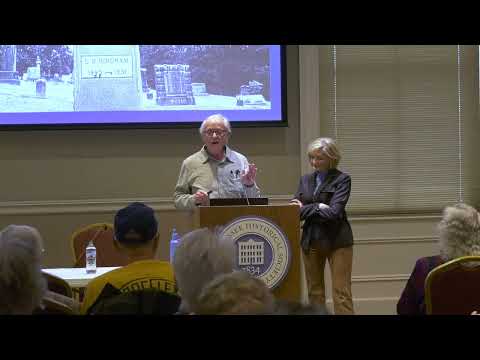
Authors recount 1931 Tennessee bank scandal and staged death at East Tennessee History Center
Summary
At an East Tennessee Historical Society brown-bag lecture, authors Kathy Turner and Leon Oliggood described decades of secrecy after a 1931 bank failure in rural Tennessee, when a burned body was passed off as the bank cashier L. “Boss” Bingham while the real man escaped to Texas under another name.
Kathy Turner, the granddaughter of the book’s subject, and co-author Leon Oligood told a packed room at the East Tennessee History Center on Feb. 28 that their book Boss Brooks traces how a small-town bank failure in 1931 led to a staged death, insurance litigation and lasting family trauma.
Turner said that after an auditor was dispatched to the Harden County Bank in winter 1931, L. “Boss” Bingham arranged an elaborate escape. "Under a cloak of darkness, they entered Shady Grove Cemetery and dug up the body of a 70‑year‑old man," she said, recounting the book’s narrative of the burned corpse being left in Bingham’s car and later identified by five men from the town.
The authors said the real Bingham fled west, assumed the name Marvin Lester Brooks and established a new life in Texas, where he married and raised children. "By the time the burned car was found it gave Boss the chance to get away," Oligood said, summarizing trial records and letters the authors recovered.
Why the insurers paid was a central legal question the book follows. Turner said Bingham held about $37,500 in life‑insurance policies when he disappeared — an amount the authors estimate equals roughly $800,000 in today’s dollars — and the policies’ terms and subsequent court rulings forced insurers into litigation. The insurance disputes played out in Harden County chancery court and reached the state supreme court, which the authors say effectively treated the man as deceased for the purposes of payment.
The presenters emphasized the difficulty of reconstructing events more than 90 years later. Many primary documents were lost or destroyed; the authors credited a trove of surviving files found in the John Ross law office in Savannah for supplying trial transcripts and letters. "We found a safe that was full of Boss Bingham stuff," Oligood said.
Turner and Oligood described the human toll: foreclosures, lost farms and families left uncertain. The book quotes courtroom testimony in which Mrs. Bingham — under repeated questioning in May 1932 — twice affirmed that her husband was "dead," a statement the speakers said carried lasting moral consequences for those involved.
Audience members pressed the authors on who in the town might have conspired to stage the death. The presenters said evidence points to influential local men — lawyers, cotton owners or lodge members — but that specific identities remain unresolved in the historical record. Turner noted conflicting local recollections and inconsistent spellings in archival sources for the town name (appearing variously in records as Saltillo, Satillo, Sautello and similar variants), and she said the authors elected to use "Saltillo" in the book where appropriate after cross‑checking multiple sources.
On forensic evidence, the presenters said there was no modern forensic testing available in 1931 (no DNA or dental analysis). Identification at the time relied on visual recognition by townsmen and the coroner’s certificate, and the authors said some have speculated those quick identifications were part of the scheme.
Turner described contacting descendants of the man whose body was exhumed; she said a great‑granddaughter in West Memphis responded with acceptance when the research team explained the findings.
The talk concluded with discussion of the book’s subtitle change (the authors added the word "forgiveness") and plans to expand readership into Texas, where local descendants did not initially know about Bingham’s Tennessee origins. Turner and Oligood said the story’s ethical complexities — community protection, loyalty, legal consequence — kept them grappling with judgment during years of research.
The authors’ book is published by the University of Tennessee Press; they encouraged attendees to consult the book’s notes and the cited court records for detailed documentation.