Get Full Government Meeting Transcripts, Videos, & Alerts Forever!
Get email alerts on the Energy Infrastructure topic
No spam. Unsubscribe anytime.
Committee advances bill to let local governments bond for thermal energy networks
Summary
The committee recommended a bill allowing local units of government to bond for thermal (geothermal) district energy networks, adopting technical and consumer-protection amendments. Testimony emphasized upfront costs, workforce opportunities and the need for municipal planning and consumer safeguards.
The State and Local Government Committee voted to recommend a bill that would enable local governments to finance and bond for thermal energy networks, a move sponsors said would unlock local geothermal heating-and-cooling projects.
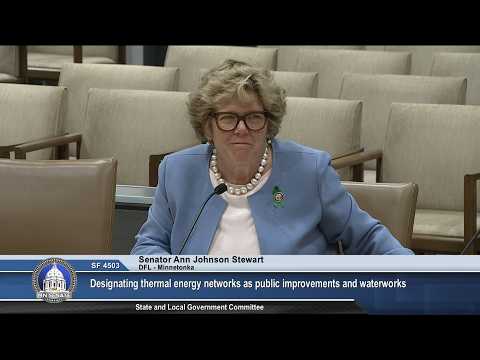
The sponsor (identified in the record as “Senator Johnson Stewart”) said the bill would allow municipalities and counties to bond for district-scale geothermal and thermal networks and pointed to federal interest and pilot programs supporting geothermal innovation. Committee members adopted a technical A2 amendment and an author’s A1 amendment to resolve conflicting definitions and add language about utilities and consumer protections.
Andrea Campell, president of the Minnesota Pipe Trades Association, testified in support, telling members that while thermal energy networks can save money over time they require substantial upfront capital and that bonding authority would create local work opportunities. "These systems have more in-depth conversation…they're complex systems and a lot of planning and permitting as well goes into them," Campell said, adding the industry can train workers and support local projects.
Committee discussion focused on municipal decision-making, cost-recovery and rate impacts. Members asked how voters and local officials would be informed, whether projects would be bid and how ratepayers might be affected if utilities recover costs through rates. Sponsors and witnesses said municipalities would follow standard capital-project processes (engineering studies, bids, permits) and that the A1 amendment contains provisions addressing utilities' role and consumer protections; the record also noted future review by relevant agencies like the Public Utilities Commission.
The committee voted to recommend the amended bill to pass and be placed on General Orders.
Next steps: with the committee recommendation recorded, the bill will proceed as placed on General Orders and may appear for further floor or cross-committee consideration.