Get Full Government Meeting Transcripts, Videos, & Alerts Forever!
Get email alerts on the Financial Fraud topic
No spam. Unsubscribe anytime.
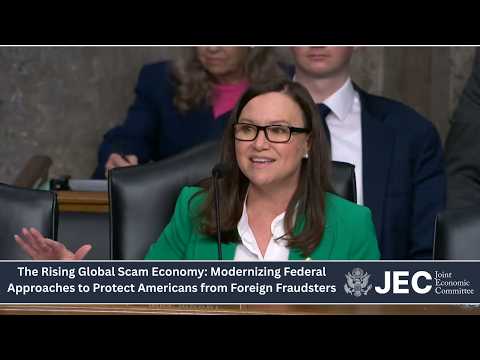
Lawmaker urges stronger federal coordination to fight tech-enabled fraud targeting seniors
Summary
At a Joint Economic Committee hearing, a lawmaker pressed witnesses for ways to amplify state anti-fraud teams and noted the confirmation of Collin McDonald as a federal "fraud czar," while an agency witness said the FBI's field-office task-force model could train and coordinate state and local partners.
At a Joint Economic Committee hearing, a lawmaker warned that technology-enabled scams are siphoning seniors' life savings and urged stronger federal coordination to combat rapidly evolving financial fraud.
The lawmaker said recent cases and trends have "shocked" members and the public and argued that the scale of losses is eroding trust in government stewardship of taxpayer dollars. "How did no one catch this? How did no one go after this?" the lawmaker asked, adding that many schemes are run from abroad or use technologies that outpace existing enforcement resources.
The lawmaker recounted experience "as Attorney General in Florida," where prosecutors and investigators were trained through a statewide cyber fraud team focused on senior protection. He described that model as a first-of-its-kind effort that enabled state authorities to aggregate apparently small cases into larger, prosecutable patterns: "Once we realized it was not just one senior — it was hundreds of seniors — all of the feds may touch that."
The member repeated a call for a federal "fraud czar" to coordinate across programs and jurisdictions and noted the recent confirmation of Collin McDonald to a related post. The lawmaker cited a recent indictment involving an alleged scheme to defraud Medicare Advantage plans for "over $90 million" as an example of the magnitude of the problem.
In response, Mr. Heeb said the FBI is positioned to help through its financial-crimes squads across the agency's 56 field offices and recommended using the task-force model to "train the trainer" with state and local partners. "I think the FBI is well-positioned to do that through our financial crimes squads," Mr. Heeb said, adding that local task-force officers and agents are important connectors in field offices.
Mr. Heeb cautioned that relying on one task-force officer or single agency is insufficient for modern fraud. He recommended expanding task-force capacity, leveraging field-office relationships, and using those offices to demystify complex investigations for state and local partners so they can be better equipped to pursue cross-border or crypto-based assets.
The hearing continued with discussion of models for training and coordination between federal, state and local investigators and how to adapt statutory tools for overseas evidence-gathering and asset tracing.