Get Full Government Meeting Transcripts, Videos, & Alerts Forever!
Get email alerts on the Calsmart Submittal Procedures topic
No spam. Unsubscribe anytime.
Transportation Commission staff walk jurisdictions through CalSmart submissions and July 1 eligibility deadline
Summary
Commission program staff briefed city and county users on how to prepare and submit adopted project lists for FY 2026–27 in CalSmart, detailing required resolution elements, key dates (July 1 initial submittal; Sept. 30 subsequent), SCO’s role in final eligibility determinations, and common compliance pitfalls.
Celeste Aceves Almanza, a program analyst for the Transportation Commission's Local Streets and Roads Program, led an online technical training explaining how cities and counties must prepare and submit adopted proposed project lists in CalSmart to establish eligibility for FY 2026–27 RMRA apportionments.
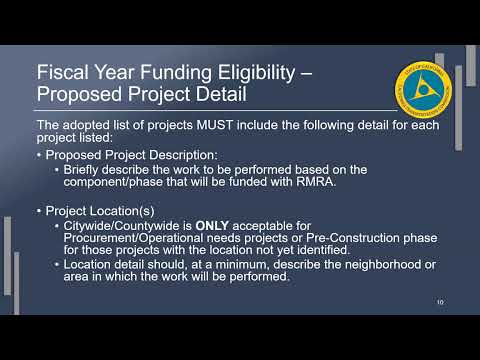
The session outlined the program timeline and the documents jurisdictions must adopt and upload. "By this July 1st deadline, cities and counties must upload a copy of the executed resolution and project list that were adopted in CalSmart," Aceves Almanza said, emphasizing that the resolution must be specific to the upcoming fiscal year and include statutorily mandated assurances. She listed the four mandatory project elements that must appear in the resolution and CalSmart entry: a project description, project location, estimated useful life, and an estimated schedule.
Why it matters: jurisdictions that do not submit an adopted resolution and project list by the listed deadlines can forfeit monthly apportionments. Staff warned that incomplete or noncompliant submissions will be returned with corrective actions and could jeopardize a jurisdiction's eligibility.
What the Commission and the State Controller do The Transportation Commission staff review submitted packages and post project lists on the commission website, provide statewide program information to the legislature, and transmit adopted eligibility lists to the State Controller's Office (SCO). "The SCO . . . are the ones that apportion and disburse RMRA funds to cities and counties," Aceves Almanza said, adding that the SCO is the final determiner of what is eligible under the program. When Commission staff cannot resolve eligibility questions, they refer jurisdictions to the SCO.
Deadlines and reporting schedule Staff set out these dates: July 1 — initial proposed project list submittal window opens and closes at 11:59 p.m.; August — Commission meeting to adopt the initial eligibility list and transmit to the SCO (transmittal must occur prior to Aug. 31); September 30 — subsequent deadline for jurisdictions that miss the July 1 submittal; December 1 — annual expenditure reports due for the preceding reporting year. Aceves Almanza stressed that amendments after formal adoption are not routine and that jurisdictions should plan to have adopted and uploaded documentation to avoid losing eligibility.
CalSmart requirements and practical tips CalSmart (California State Multimodal Application and Reporting Tool) is the required submittal platform. Staff walked attendees through registration (one email per agency), dashboard navigation, and the help/resources tab, which contains the FAQ, sample resolution, and screenshots of the submission workflow. The system requires upload of a resolution (even a draft) before a jurisdiction can complete the intake. Entries in CalSmart must mirror the adopted resolution; mismatches will trigger a kick-back for correction.
On relisting and multi-year projects Relisting is permitted when a project is intended to use the upcoming fiscal year's apportionment; jurisdictions should re-list only when necessary. Celeste warned against adopting broad multi‑year construction plans or using capital improvement plans in place of a fiscal-year-specific resolution because such documents often omit required details and increase the risk of noncompliance. She recommended identifying multi‑year elements clearly (pre-construction vs. construction) and including schedules for each funded component.
Common questions from attendees - Q: "Is the July 1st deadline only for new projects?" A: Any project (new or already in CalSmart) that will use the upcoming fiscal year's apportionment must be adopted and submitted. (question from Jennifer) - Q: "Can one resolution cover multiple years?" A: No — the resolution must be specific to the fiscal year of funding (Nicole). - Q: "Can locations be described by council district or general area?" A: Descriptions must be identifiable to the general public; if constituents cannot reasonably identify the area from the description, it is insufficient.
Program scale and practical consequence Staff said the local streets and roads program currently apportions roughly $1.77–$1.8 billion annually statewide and that allocations change year to year. Missing the initial or subsequent deadlines can result in a jurisdiction losing eligibility for its formulaic monthly apportionments; staff urged jurisdictions to use the sample resolution and to submit drafts early for Commission review.
Next steps and resources The Commission will post a recording of the training and the technical slides in the CalSmart help/resources page. Staff encouraged jurisdictions to send draft resolutions for pre-submittal review and to reach out with specific questions about relisting, forecasting, and special cases.
The Commission did not take any formal votes during the training; the session concluded with a live demonstration of the submit-for-review workflow and a reminder that adopted, uploaded resolutions must match CalSmart entries to be accepted.