Get Full Government Meeting Transcripts, Videos, & Alerts Forever!
Get email alerts on the Local Government Reform topic
No spam. Unsubscribe anytime.
Granite County study commission plans tentative ballot measures after survey favors shorter commissioner terms
Summary
A first public hearing produced survey results showing 63.8% support for shortening county commissioner terms from six to four years and a near-even split on making elections nonpartisan; the commission will draft a tentative report and seek written legal confirmation before finalizing ballot language ahead of an Aug. 10 submission deadline for the Nov. 2026 ballot.
At a public hearing, the Granite County Study Commission reviewed results from a community survey and agreed to draft a tentative report recommending two possible ballot items: shortening county commissioner terms from six years to four and deciding whether to make commissioner elections nonpartisan.
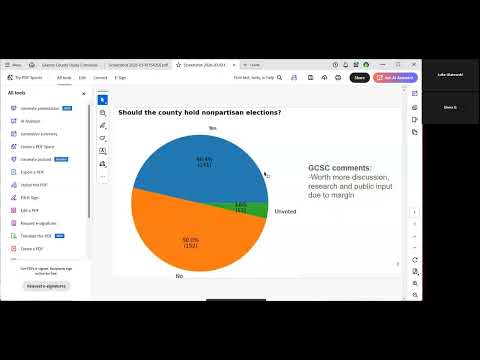
The hearing, opened by the commission chair, centered on two survey findings the commission said were actionable. According to the figures presented, 63.8% of survey respondents supported changing commissioner terms from six to four years (32.2% opposed, 3.9% no response). The question of shifting commissioner elections to nonpartisan contests was close: about 46.4% favored nonpartisan contests while roughly 50% opposed it, with the remaining responses not recorded, the commission said.
Why it matters: shortening term lengths would change the cadence of county elections and potentially increase the frequency of turnover for commission seats; whether to remove party labels on ballots could affect how candidates campaign and how voters evaluate choices. Commission members said placing either question on the November 2026 ballot would let county voters decide.
Commissioners and members of the public urged careful outreach and clear timing. Christy Mainwearing, who said she serves on the Granite County Medical Board, told the commission she was “passionate about it because I've seen and lived through the mistakes of putting off decisions that should have been made before,” and urged wider public engagement to improve turnout and understanding.
Legal and procedural steps: members reported that county attorney Blaine Bradshaw had orally agreed to provide limited legal counsel. Commission members said Bradshaw indicated ballot language for the Nov. 2026 general election must be finalized by Aug. 10 and that the paperwork for any resolutions following two public hearings should be submitted about three weeks before that deadline. Several commissioners, notably Elena, insisted they receive the county attorney’s commitments and the scope of the offered counsel in writing before relying on that advice. “I expect everything in writing and documented,” Elena said during the meeting.
Next steps: the commission agreed to prepare a tentative report and cover letter summarizing the study commission’s history and the recommended ballot items, schedule another public hearing for feedback before a final report, and consider inviting outside counsel or advisor Dan Clark to explain the broader implications of any change in form of government. The commission set its next meeting for April 1 at 6 p.m. at the courthouse by voice vote.
What was not decided: the commission did not adopt final ballot language, nor did the county commission vote on any resolution at this meeting. Questions about whether prior county-commission resignations followed the Montana Codes Annotated were raised but not resolved during the session; members said those procedural concerns would remain part of the record as the commission moves forward.
The study commission adjourned after setting the next meeting and agreeing to prepare the tentative report and confirm legal counsel in writing.