Get Full Government Meeting Transcripts, Videos, & Alerts Forever!
Get email alerts on the Ems Recognition topic
No spam. Unsubscribe anytime.
Trinity paramedics credited with saving woman after cardiac arrest at Lakeidge
Summary
City officials recognized Trinity paramedics Kyle Carney and EMT Jeremy Greenwood for resuscitating a woman who collapsed March 1 at Lakeidge; hospital staff praised on-scene care, and the patient was transferred by LifeStar and later extubated with no apparent neurologic deficits.
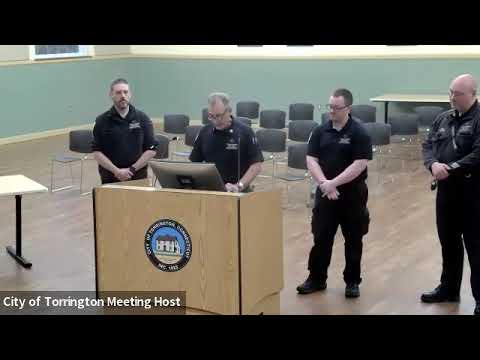
Jeff, a city presenter, opened the meeting by recognizing Trinity EMS personnel who responded to a cardiac arrest on March 1 at Lakeidge, specifically naming paramedic supervisor Alex Limbos (not present), paramedic Kyle Carney and EMT Jeremy Greenwood.
Jeff read a physician's account from the Charlotte Hungerford emergency department describing immediate bystander CPR, three AED shocks from ski patrol, intubation with a video laryngoscope, and further advanced cardiac life support measures that produced a return of spontaneous circulation. He said the crew performed synchronized cardioversion when the patient developed a slow but pulsed rhythm and began vasoactive support with epinephrine and norepinephrine, alongside an amiodarone infusion to suppress recurrent ventricular arrhythmia.
According to Jeff, the patient arrived at the hospital with multiple IV and intraosseous access points and was transferred to Hartford Hospital via LifeStar. Jeff told the board that by the time the patient left the emergency department she was following commands and later was extubated; the hospital reported no apparent neurologic deficits. Hospital staff advised the team that the arrest did not appear to be caused by a blockage requiring coronary intervention; clinicians plan to implant an internal defibrillator for primary prevention of future lethal arrhythmias.
Mayor and other board members thanked the crew and noted the successful chain of survival — rapid bystander CPR, early AED use, and advanced prehospital care — as factors that helped preserve the patient’s neurologic outcome. Jeff said the family was deeply grateful and added, “They truly saved this woman’s life.”
Why it matters: board members highlighted the episode as an example of how changes in advanced cardiac life support and prehospital equipment, including video laryngoscopes on paramedic monitors, are contributing to more patients surviving and leaving the hospital with preserved brain function.
Next steps: the recognition concluded with formal thanks from the board; no formal action was required.