Get Full Government Meeting Transcripts, Videos, & Alerts Forever!
Get email alerts on the Hopewell Pud topic
No spam. Unsubscribe anytime.
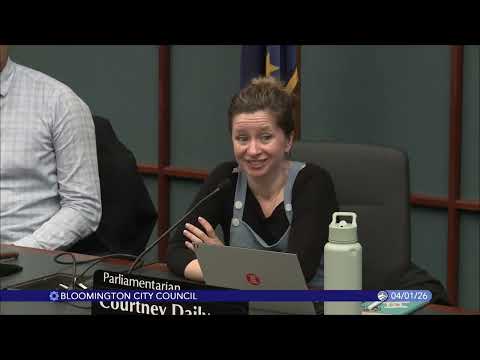
Bloomington council delays vote on Hopewell PUD after hours-long debate over affordability, sidewalks and legal authority
Summary
After hours of testimony and legal exchanges, the Bloomington Common Council postponed action on the Hopewell plan‑unit development to April 22 so members and staff can negotiate affordability levels, sidewalk and tree‑plot standards and fire‑access design.
The Bloomington Common Council postponed final action on the Hopewell plan‑unit development (PUD) after a nearly four‑hour public hearing during which council members, city staff, the project team and local housing advocates debated whether the proposal meets the city’s affordability, transportation and fire‑safety standards.
Mayor Thompson, who urged council to hold a series of working meetings through April to finalize details, framed the day’s debate as an effort to balance urgency and care. “I call on every council member and myself to conduct a series of meetings throughout the month of April to pound out the final details of Hopewell’s initial phase,” the mayor said, asking colleagues to use the extra time to reach a mutually agreed strategy.
Why it matters: The Hopewell site — roughly 6.3 acres identified in the RDC petition — is public land the city acquired to pursue attainable housing. The draft PUD would allow a denser, compact neighborhood with as many as the developer’s illustrations suggested could be 90‑plus homes; council members said they want clearer commitments on the mix of permanently affordable units, pedestrian infrastructure and construction standards before finishing the rezoning.
Major points of contention - Affordability target: Council sponsors pushed for up to 50 percent of dwellings to be permanently affordable (with sub‑targets at about 90% and 120% area median income for portions of that total). City staff and the petitioner’s counsel warned that moving from the UDO’s baseline (a 25% permanent‑affordability trigger for qualifying PUDs, as described in the UDO) to 50 percent would materially change project economics and could require an updated plan or re‑submittal.
- Sidewalks, tree plots and transportation plan: Council members asked that sidewalks and tree‑plot standards match the city transportation plan’s preferred sections (six‑foot sidewalks and defined tree‑plot widths in many locations). The petitioner argued that enforcing the plan’s typical cross‑sections across every block would reduce the number of buildable lots substantially. Officials and designers also discussed whether certain narrower road sections could be justified in constrained blocks.
- Fire access vs. street design: The council debated whether to narrow alley/traveled‑lane widths to create room for larger pedestrian zones and tree plots. Fire Department leadership and the petitioner’s design team discussed three possible approaches: (a) provide automatic sprinklers to allow narrower access, (b) use a 150‑foot hose‑reach strategy so not every alley is a primary fire access route, or (c) design a reinforced, mountable central pedestrian/utility corridor to carry occasional apparatus. Fire Chief Roger Kurt said the state fire code normally requires 20‑foot‑wide fire access unless a code exception applies.
Legal dispute over "reasonable conditions" Council and outside counsel offered contrasting legal views about how far the legislative body may go in imposing "reasonable conditions" when adopting a PUD. Clark Kirkman, an attorney the council engaged, described the statute that governs PUDs (the 1500 series and especially section 1512) and said the council does have the authority to adopt reasonable conditions when it approves a PUD. Dana Kerr, assistant city attorney advising the redevelopment commission (the petitioner), said council-imposed changes that alter the PUD text or exhibits could legally be classified as an amendment and therefore would require the petitioner’s concurrence or a re‑submittal back to the RDC/plan commission. Both legal positions were put on the public record during the meeting.
Voices from the room - Ally Quinnland Thurman, presenting as the city/plan team lead, said the plan had been vetted by city departments and that many of the council’s proposed changes would have cost and dimensional impacts requiring recalculation of stormwater, utility and construction assumptions. She cautioned that some conditions could demand returning to plan commission for re‑review.
- Nathan Fer, executive director of Summit Hill Community Development Corporation (a community land trust operator), urged flexibility on mechanisms for long‑term affordability and warned that deed restrictions and land‑trust models each carry different underwriting and resale implications for lenders and buyers.
- Several public commenters, including modular housing proponent Claudia Brink and members of the local housing and business community, urged the council not to delay the project while ideas are tested — but they also asked for workable affordability mechanisms.
Next steps By motion, the council postponed final action to the council’s April 22 meeting to allow the council, the RDC and staff to negotiate specific, legally viable conditions and to continue technical analysis of sidewalks, tree plots, fire access, and affordability mechanisms. The council also signaled use of a deliberation session in mid‑April for deeper discussion.
What the council asked for in coming weeks: clearer cost estimates tied to any required changes (for example, added sidewalk width or sprinkler requirements), more precise language about how "permanent affordability" will be delivered (deed restriction, ground lease, first‑right‑of‑refusal/shared‑equity model), and updated site sections showing where transportation‑plan elements can be met without losing the bulk of the proposed lots.
The ordinance remains pending; the council will revisit the PUD on April 22 after the administration and petitioners provide supplemental materials and after the council’s deliberation session on the plan.