Get Full Government Meeting Transcripts, Videos, & Alerts Forever!
Get email alerts on the Education topic
No spam. Unsubscribe anytime.
Creighton Elementary District credits quarterly learning walks with measurable teacher growth after hundreds of classroom visits
Summary
Creighton Elementary District leaders say their learning-walk teams, using a Danielson-aligned rubric and tools such as Classroom Mosaic, have visited more than 600 classrooms this year (637 cited), providing non-evaluative feedback, targeted coaching and quick technology fixes to support instruction across nine schools and about 4,300 students.
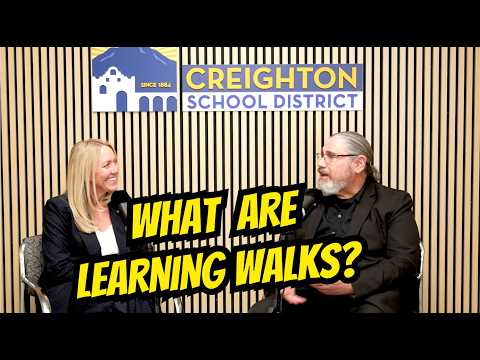
Jay Mann, superintendent of the Creighton Elementary District (4263), and Dr. Kim Dotson Karen described a districtwide learning-walk program that officials say is helping teachers refine classroom practice through non-evaluative observation, immediate feedback and targeted coaching.
"You don't get a coach because you're not good. You get a coach because you are good and you want to be better," Mann said, using a personal hobby as an analogy for seeking improvement. Dr. Kim Dotson Karen said learning walks in Creighton are conducted by cross-functional teams that visit every classroom on a campus and use a rubric aligned to the Danielson framework to focus observations.
The teams include principals, assistant superintendents, content coaches, special education and behavior staff and instructional-technology leaders, Karen said. Observers look for planning and preparation, visible learning targets and success criteria, classroom organization and student engagement; when appropriate they speak briefly with students to confirm whether learners can explain what they are doing and why.
Karen said the district ties specific rubric items to its student-outcomes-focused governance goals and interim measures, and reports out on guardrails each April. "We want to be sure that everything we're looking for is helping to coach and support a teacher in what they one day will be evaluated on," she said.
Mann and Karen said learning walks are quarterly and that the district has completed more than 600 classroom observations this year; Karen cited 637 as the latest figure. In a nine-school district serving about 4,300 students, the practice is intended to give leaders sustained, actionable information rather than one-off checks.
They emphasized that learning walks are not meant to be punitive. Karen described an instructional-technology example in which observers noticed teachers were tethered to district iPads; Russell, the district's director of instructional technology, followed up by supplying stylus pens and visiting classrooms to show teachers how to use the devices in ways that allow closer proximity to students.
That sort of rapid, practical support is a recurring outcome of the debrief process, Mann said. Teams debrief together after visits, principals take targeted feedback back to their staff, and coaches return to classrooms to help teachers implement small shifts that address pacing, engagement or organization.
Karen said the district is working to strike a balance between districtwide patterns (for example, pacing problems that appear across multiple campuses) and site-specific goals tailored to particular campuses. Feedback is delivered via a digital tool (Classroom Mosaic) or handwritten notes depending on campus preference; principals and teachers are asking for clear, simple actions that will move rubric scores from one level to the next.
As a practical takeaway, Karen urged teachers to "get to know your students" and plan intentionally for individual needs such as reading preferences or movement needs, which she said can improve engagement and reduce behavior disruptions.
Mann said the district will present learning-walk results and next steps at an upcoming board meeting and will use summer design work to refine curriculum tools and resources so teachers have helpful materials at their fingertips.
The podcast episode focused on process, examples and next steps; no formal board actions or votes were recorded in the conversation.