Get Full Government Meeting Transcripts, Videos, & Alerts Forever!
Get email alerts on the Health Insurance topic
No spam. Unsubscribe anytime.
Virgin Islands senators reject bill to form committee for self‑funded government health plan after lengthy testimony
Summary
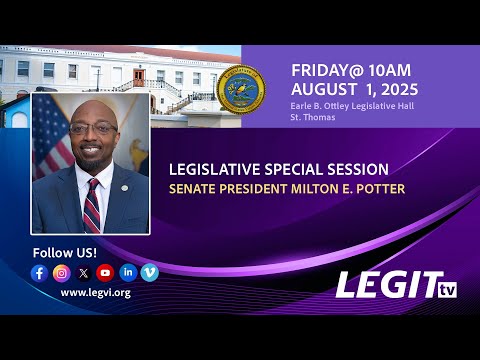
After hours of testimony and debate on risks, costs and provider payment stability, the 36th Legislature voted down Bill 36‑0126, which would have created a special committee to issue an RFP to study a self‑funded group health and dental plan. Two governor‑requested bills were removed from the special‑session agenda earlier under preemption rules.
The 36th Legislature on Aug. 1, 2025, voted against Bill 36‑0126, which would have established a special committee to issue a request for proposals to assess whether the government should move to a self‑funded group health and dental insurance plan for employees and retirees. Earlier in the special session the body removed two additional governor‑requested measures from the agenda after a first‑to‑file preemption challenge.
Proponents framed the bill as an informational step, not a commitment to change. “This bill does not mandate a shift to self‑funding, nor does it prejudge the outcome,” Cindy Richardson, director of the Division of Personnel, told senators, urging an RFP to gather pricing, stop‑loss, reserve and transition information. Office of Management and Budget Director Julia Rhymer said the government’s health insurance costs rose from about $154.4 million in fiscal 2019 to an estimated $226 million for fiscal 2026, arguing the RFP would let lawmakers consider alternatives with data rather than assumptions.
Opponents and cautionary witnesses emphasized operational and patient‑care risks. Beverly Joseph, chair of the GESC Health Insurance Board of Trustees, summarized the board’s analysis and cautioned that self‑funding exposes the government to large, unpredictable claim spikes and administrative burdens. The Garing Group, a consultant to the board, presented analyses showing modest potential savings in one model (about 2.5%, roughly $4.3 million) versus a projected 19.5% fully insured renewal increase; the board’s white paper and exhibits were cited repeatedly during debate.
Health providers and senators pressed the government on payment timeliness and liquidity. “The provider community is not opposed to self‑insurance,” said Dr. George Rosenberg, a provider testifying at the hearing, “but they are terrified that if such a system were implemented in this situation it could be catastrophic” because delayed government payments have in the past disrupted provider finances. Senators cited recent increases in high‑cost conditions such as cancer, diabetes and hypertension as reasons to be cautious about any change that could interrupt claims payments.
Questions from senators focused on governance and statutory authority. Multiple senators asked why the special committee proposed in the bill would operate separately from the Government Employees’ Service Commission (GESC) health insurance board, which by statute oversees procurement for the group health plan. Richardson and other administration witnesses said the bill’s drafters sought an independent RFP process to avoid perceived conflicts and to ensure broad, cross‑branch review; GESC leadership said the board already receives and reviews the same data and urged collaboration rather than circumvention.
Votes at a glance: • Bill 36‑0124 (Double‑dipping/leave requirement): motion to remove from today’s agenda passed by roll call (Clerk announced 12 yes, 1 no, 2 absent). The measure will be vetted in committee of jurisdiction. • Bill 36‑0125 (Simultaneous annuity payments): motion to remove from today’s agenda passed by roll call (Clerk announced 13 yes, 2 absent). The measure will be vetted in committee of jurisdiction. • Bill 36‑0126 (special committee to issue RFP for self‑funded group health/dental): Committee debate led to a final unfavorable vote; the chair announced the bill received an unfavorable vote and the governor will be notified.
What happened next: Senators and administration officials agreed the conversation should continue. Several senators urged further analysis, stronger fiscal controls and closer collaboration among the executive branch, the GESC board and the Legislature before any structural change is made to the government’s health‑insurance financing. The special session was adjourned.
Why it matters: The government’s group health plan represents a major recurring expense and affects thousands of employees and retirees. Lawmakers must balance potential budget savings against the risk of interrupted payments, vendor and provider stability, and the operational capacity required to run a self‑insured program. The session left the central question unresolved: gather more evidence and plan capacity before committing to a change that could affect access to care and the government’s fiscal stability.