Get Full Government Meeting Transcripts, Videos, & Alerts Forever!
Get email alerts on the Energy Taxes topic
No spam. Unsubscribe anytime.
House committee rejects referral of bill that would cut energy taxes and RDA payments
Summary
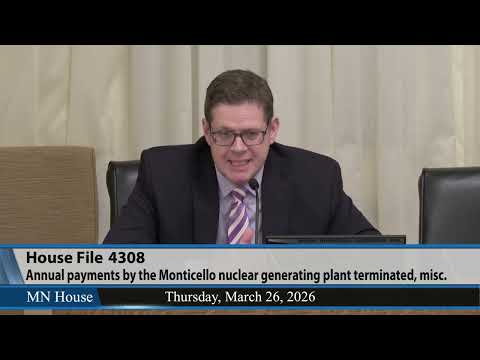
A House committee heard competing testimony on House File 4308, which would remove certain Monticello cask fees, eliminate sales taxes on residential energy, and change distributed‑solar rules; after debate and testimony from Xcel Energy and solar advocates, a motion to refer the bill to taxes failed.
A Minnesota House committee debated House File 4308 on April 6, a package of energy‑tax changes that would eliminate certain payments into the Renewable Development Account (RDA), remove sales taxes on residential energy year‑round and narrow Minnesota’s distributed solar standard. After debate and testimony the committee declined to refer the bill to the committee on taxes.
The sponsor introduced the bill and moved a series of amendments that the committee adopted. Nonpartisan staff outlined the bill’s main provisions: it would strike an annual requirement for the Monticello nuclear plant to pay into the RDA per dry cask and would remove a statutory requirement that, once Monticello is shut down, a larger annual payment continue. The bill would also create conditions under which a utility could be exempt from the state’s 3% distributed‑solar requirement for projects 10 megawatts or smaller, and would remove certain utility property from tax capacity calculations, a change staff said would reduce statewide property taxes by about $90 million.
Jim Pearson, a regional government‑affairs official for Xcel Energy, told the committee eliminating the cask fees imposed since 2007 would lower customer charges by roughly $10.5 million today and potentially about $15 million by 2028 as additional dry storage comes online. “We are looking at savings to customers if those fees were removed,” Pearson said, urging the panel to consider market changes that affect the distributed solar requirement.
Patty O’Keefe, identified as a regional director for a solar advocacy organization, urged the committee to reject the bill. She said weakening the distributed solar standard now would undercut a recent compromise and that generation‑only cost comparisons do not capture the full system benefits of distributed solar. O’Keefe also warned that the RDA funds — including payments tied to dry casks — support local mitigation and innovation projects and that eliminating those payments would shift costs and risks.
Members pressed for a fiscal note and sought clarity about whether any tax reductions would actually translate into lower customer bills. A committee discussion highlighted competing priorities: some members emphasized near‑term relief for ratepayers and reducing statutory burdens on utilities; others emphasized preserving RDA funding streams that finance local projects and research and protecting conservation programs shown to reduce bills.
After a roll‑call vote on a motion to refer House File 4308, the chair announced the motion did not pass and that the bill would not move out of committee.
The committee did adopt the A1 and A2 amendments earlier in the hearing; those amendments and the bill text remain part of the record. The bill’s fiscal impacts were described in rough terms during testimony (nonpartisan staff and witnesses referenced preliminary estimates in the order of hundreds of millions statewide for some changes and a roughly $100 million estimate tied to sales‑tax changes), and the committee requested a formal fiscal note before further consideration.
Next steps: the bill remains in committee; no formal referral occurred and no final policy action was taken at this meeting.