Get Full Government Meeting Transcripts, Videos, & Alerts Forever!
Get email alerts on the Local Sales Tax topic
No spam. Unsubscribe anytime.
Senate Taxes Committee hears local sales‑tax requests, nonprofit thrift tax change and hospitality fixes
Summary
The Senate Taxes Committee on March 26 reviewed multiple local-option sales-tax proposals from cities and counties across Minnesota, a bill to reclassify nonprofit thrift stores under the solid‑waste tax, and technical fixes to tourism and hospitality tax rules. Testimony emphasized regional benefits and voter referenda; several amendments were adopted and bills were laid over for further action.
The Minnesota Senate Taxes Committee met March 26 to hear a series of local-option sales-tax petitions and several tax‑policy bills affecting nonprofits, tourism districts and hospitality enforcement.
The committee heard multiple requests from cities and counties seeking local-option sales taxes that would go to regional infrastructure projects and public facilities. A bill to extend tax‑increment financing authority for the Eden Prairie Center redevelopment was presented as a time‑limited extension to 2028 so the city can continue negotiations with mall owners and developers. A city official told the committee the project remains under negotiation and needs more time to finalize development plans.
Senate File 36‑94 would authorize a local sales tax up to one‑half of one percent, if approved by voters, to fund regional projects including two fire‑station upgrades and renovation of the Marsh community wellness center; the bill’s sponsor said the measure would allow the city to issue up to about $65.06 million in bonds and would terminate after 30 years or when the target amount is raised. "We have an opportunity to reinvest in these essential community assets so they can serve residents, workers and visitors safely and effectively for years to come," Mapleton‑area testimony said.
Maplewood Mayor Mary Lee Abrams asked the committee to allow a ballot question for voters to decide on a half‑cent tax to finance an East Metro public‑safety training facility and a regional community center. "More than 60% of those using the Maplewood Community Center are not residents of Maplewood," Abrams said, describing the facility’s regional use and partnerships with Century College and neighboring jurisdictions.
Senator Westrom presented a group of requests from western Minnesota. Douglas County requested authority to put a one‑quarter‑percent sales tax before county voters to finance a new 34,000‑square‑foot county library and related facilities, with testimony noting donated land valued at $1.4 million and broad regional use. Alexandria city officials described a phased community‑center project that includes arena space and event facilities; the city’s administrator told the committee the center draws users from dozens of cities and counties and cited an estimated annual economic impact figure provided by local tourism officials.
A Sauk Centre measure would seek to increase a previously authorized local sales tax cap from $10 million to up to $20 million because of post‑COVID cost increases and new stormwater and corridor requirements; the sponsor said the measure would still be subject to a new, local referendum.
On tax policy, Senate File 24‑37 (as amended) would change the definition of "residential generator" under the solid‑waste tax to include nonprofit thrift stores that accept donations for resale. Emily Barker of Reuse Minnesota testified that much of the material handled by thrift stores originates as residential donations and that reclassifying those nonprofits to the residential tax rate (lower than the commercial rate) would help organizations reinvest more into community services. "Nearly all of what is thrown away are items that are broken, dirty or otherwise unsellable," Barker said, arguing the change recognizes operational reality while modestly reducing tax receipts.
Senate File 45‑18, amending the tourism‑improvement law, would clarify that a separately stated hotel or tourism district fee shown as a line item on a guest’s bill is not part of the sales price subject to sales tax if the charge is imposed on the consumer. Meet Minneapolis and other industry representatives supported the clarification and asked for retroactive application; the Department of Revenue told the committee refunds would generally be processed by businesses filing for adjustment during their sales‑tax period.
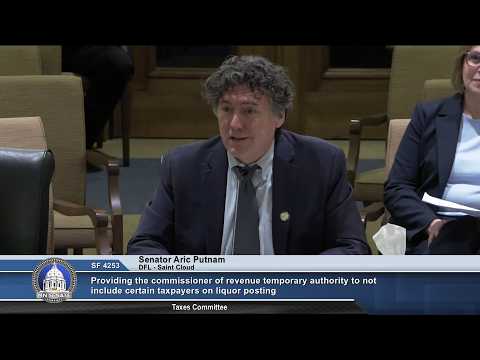
Senate File 42‑53 would give the commissioner of revenue discretion to refrain from liquor‑posting (an enforcement tool that prevents wholesalers from delivering taxable liquor to a business) for qualifying hospitality businesses that have filed for tax abatement, permitting those establishments to continue operations while seeking relief. Hospitality Minnesota and other industry voices said the change creates a temporary bridge to preserve operations. The bill’s author offered an amendment to extend the temporary expiration to 2027; committee members adopted the authors' amendment.
Several authors’ amendments were adopted during the hearing and multiple bills were laid over for additional consideration. Committee members asked departmental and fiscal staff for follow‑up on implementation details — including the refund process for any retroactive tourism fee change and whether certain projects might be eligible for additional state cost‑participation support — before final disposition.
What happens next: the committee laid several bills over for later action and asked sponsors and agencies to provide clarifications requested during questioning. Voter referenda remain prerequisites for the local‑sales‑tax measures; none of the measures reported final enactments at the March 26 hearing.