Get Full Government Meeting Transcripts, Videos, & Alerts Forever!
Get email alerts on the Elections Policy topic
No spam. Unsubscribe anytime.
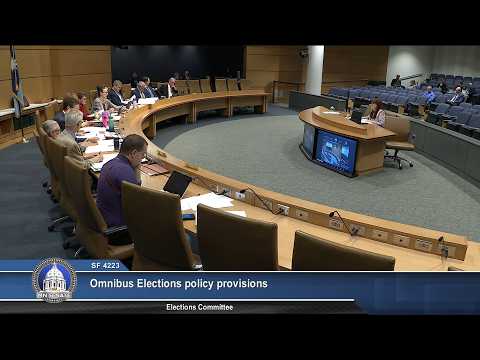
Senate elections omnibus advances from committee after votes on absentee timelines, disclosures
Summary
The Minnesota Senate Elections Committee on March 26 voted to send the elections policy omnibus (SF4223) to the floor after adopting multiple amendments addressing absentee voting windows, campaign‑finance disclaimers, and candidate information. Testimony came from the Secretary of State’s office, campaign‑finance counsel and municipal representatives.
The Senate Elections Committee voted March 26 to recommend the elections policy omnibus, Senate File 4223, to the full Senate after adopting several amendments addressing absentee voting schedules, campaign‑finance disclaimers and candidate information.
Nicole Freeman of the Office of the Secretary of State told the committee the omnibus incorporates practical updates from SF4006 and “allows cities flexibility if they administer absentee voting to do so for the full 46 days or just the final 18 days ahead of an election,” a change she said would help manage costs while preserving voter access.
The amendments adopted included the A5 amendment (adopted by roll call), a compromise A14 amendment clarifying how counties and municipalities should agree on absentee opening days for the 2026 primary, and AE11 which narrowed disclaimer rules for material capable of redistribution. The committee recorded the final recommendation to pass SF4223 by a roll‑call vote of six yeas and five nays.
Why it matters: The omnibus packages technical fixes, campaign‑finance updates and procedural changes affecting how absentee voting is implemented and how political spending is disclosed online. Supporters said the changes modernize administration and protect voters; opponents argued some provisions do not address their concerns about election integrity.
Testimony and debate Nicole Freeman, speaking for the Secretary of State’s office, framed provisions as operational updates that ‘‘improve consistency and coordination across elections’’ and noted the bill would repeal an outdated licensing authority related to the statewide voter registration system. Elizabeth Shimek, senior legal counsel for a nonpartisan campaign‑finance organization, urged stronger coordination rules and clearer digital disclaimers so ‘‘voters have a right to know who is spending big money to influence elections.’’
Cap O’Rourke, representing the Minnesota Association of Small Cities, urged that new economic‑interest filing requirements could burden small municipalities and asked how the bill would resolve disputes if counties and cities disagree about who administers absentee ballots and for how long. A witness who identified themself in testimony as Chipp Engen, describing themself as a third‑party activist and an intended candidate, urged scrapping paper nominating petitions and removing a requirement that signers list year of birth.
Members exchanged partisan arguments in closing debate. Sen. Lucero and others expressed concern over removing certain candidate address requirements; Sen. Westlin raised constituents’ concerns about election fraud and said more could be done on integrity; Sen. Marty defended Minnesota’s election administration and called for working in good faith across the aisle. Chair closed by thanking staff and emphasizing protections included in the omnibus for election officials and voters.
Votes and next steps Committee members adopted several amendments during the hearing (including A5, A14 and AE11) and ultimately recommended SF4223 to pass to the Senate floor (committee vote recorded as six yeas, five nays). The bill will proceed to the full Senate for further consideration.
Clarifying details: The A14 amendment clarifies that, for the 2026 state primary only, a municipality and county must agree on whether absentee in‑person voting sites open 46 days or 18 days before the election; the record does not specify a default if the two jurisdictions cannot agree beyond 2026. The AE11 amendment requires prominent disclaimers on content that can be redistributed (for example, videos or downloadable materials) rather than making every linked page the only permissible place for the disclaimer.
The committee also noted that the Campaign‑Finance and Public Disclosure Board generally enforces disclaimers reactively (by complaint) and lacks resources for proactive scanning.
Ending: SF4223 was recommended to the Senate floor; members indicated some items may be further refined on the floor or in subsequent negotiations.