Get Full Government Meeting Transcripts, Videos, & Alerts Forever!
Get email alerts on the Battery Stewardship topic
No spam. Unsubscribe anytime.
Committee advances battery stewardship bill after safety and cost testimony
Summary
The Commerce Committee amended and recommended Senate File 1690, a statewide battery stewardship program focused on loose/removable batteries; proponents cited rising thermal events and heavy insurance costs for recyclers, while industry urged harmonization and cautioned on large-format batteries.
The Commerce and Consumer Protection Committee advanced a substantially amended stewardship bill (Senate File 1690) focused on battery collection and recycling after an extensive round of stakeholder testimony and committee amendments.
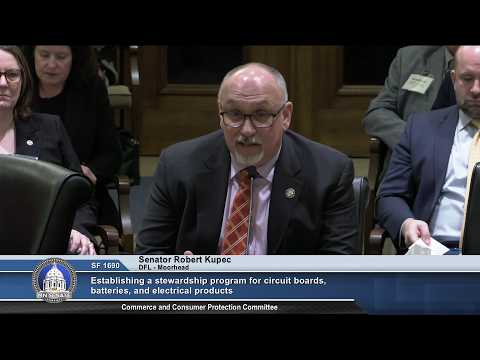
The author framed the measure as a modernization of Minnesotalaw to address the growing risk of battery-caused fires at recycling and waste-handling facilities and to recover critical materials. The committee adopted a delete-everything amendment that turned the prior draft into a battery-only stewardship bill and later approved a technical A7 amendment clarifying how recalled batteries and certain costs are handled.
KIRK A DELCAMBRE, Commissioner of the Minnesota Pollution Control Agency, explained the A7 amendment addresses recalled batteries, removes clarifying cleanup language back to existing law for some battery types, and narrows examples about underserved communities. "This would allow for those to be covered at collection sites, but it does not absolve manufacturers from having to cover the recall," he said.
Washington County Commissioner KARLA (testifying on behalf of counties) described frequent and costly incidents tied to lithium-ion batteries, said insurance premiums for some counties have jumped sharply and recounted local fires that caused hundreds of thousands in damages. "Our insurance premiums have increased 631%." she said, and testimony included examples of a truck fire in Becker County causing about $800,000 in damage and another fire causing about $500,000 in Rice County.
Recyclers and industry groups largely supported a focused battery program but urged narrow coverage for small and medium portable batteries and cautioned that large-format batteries require different systems. DAVID POTTER (president of Global Leeway Solutions) and LUCY (vice president, Eureka Recycling) described operational steps to reduce thermal events and called for an expansion of collection sites. Industry representatives (including AMBER BAUCUS of the National Waste & Recycling Association and MARK FOOLISH of the Rechargeable Battery Association) supported many changes but asked for harmonized definitions and careful treatment of large-format batteries and reimbursement language.
After committee questioning about costs to producers, enforcement, existing collection networks and whether the state would operate facilities, the committee voted to recommend SF1690, as amended, be passed and referred to the Environment, Climate and Legacy Committee.
Next steps: the bill was recommended to the Environment, Climate and Legacy Committee for further consideration; sponsors said embedded (non-removable) batteries and broader electronics recycling work would continue in follow-up efforts.