Get Full Government Meeting Transcripts, Videos, & Alerts Forever!
Get email alerts on the Energy Finance topic
No spam. Unsubscribe anytime.
D.C. Council lifts CPACE bond cap to clear way for large energy‑efficiency deals
Summary
The council passed emergency and temporary measures removing a $250 million cap on CPACE financing, enabling larger privately financed energy‑efficiency projects and paving the way for a large Geneva conversion project. Sponsors said the measure will spur private investment; members sought reassurances on affordability commitments.
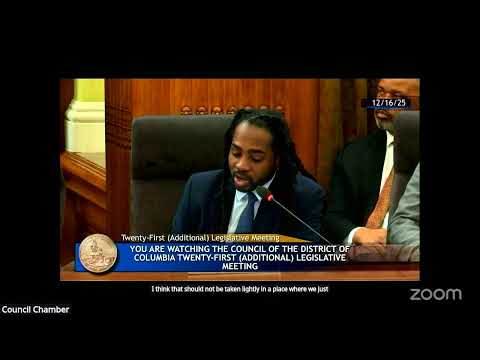
The D.C. Council approved emergency and temporary legislation on Dec. 16 to remove a $250 million statutory bond cap on the District’s Commercial Property Assessed Clean Energy (CPACE) program, a step sponsors said is necessary to accommodate larger privately financed energy‑efficiency projects.
Council Member Jack Allen, sponsor of the emergency declaration, told colleagues the cap — established when the program was a proof of concept in 2010 — now constrains private market appetite. The DC Green Finance Authority reported the CPACE program had used about $184 million of the authorized $250 million and identified a near‑term opportunity to support a roughly $470 million bond issuance for a conversion project at 1825–1875 Connecticut Avenue NW (the Geneva). Allen said CPACE transactions use private capital and that removing the cap does not obligate public funds.
Council members asked whether the Geneva deal includes deep affordability and how many projects are currently supported under the cap; Allen said the project proposal included 61 units at 60% area median income and that more detailed deal terms would be negotiated by the Green Bank and developers. The emergency declaration, the related temporary amendment (Bill 26‑536), and the underlying bill were approved by the council; the emergency declaration and related measures passed unanimously on voice votes.
Supporters said eliminating the cap would unlock private investment for energy retrofits and conversions, help the DC Green Bank earn administrative fees to sustain operations, and accelerate climate‑related upgrades in building stock. Members acknowledged the need to evaluate longer‑term policy guardrails during follow‑up work to ensure projects deliver public benefits (for example, deeper affordability or workforce commitments) when appropriate.
The emergency action is time‑limited; permanent legislative changes and additional oversight of CPACE terms are expected to follow as council staff and the Green Bank lay out implementation details.