Get Full Government Meeting Transcripts, Videos, & Alerts Forever!
Get email alerts on the Wild Rice Pesticides topic
No spam. Unsubscribe anytime.
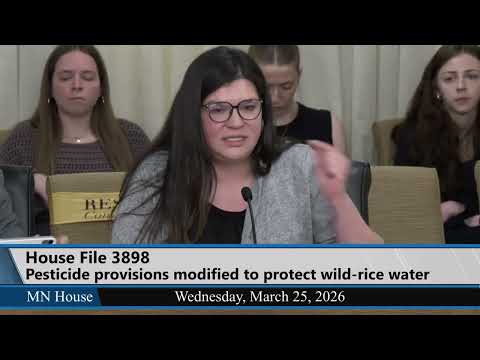
Committee hears bill to fold wild‑rice protections into pesticide plans; advocates urge tribal consultation
Summary
Lawmakers heard House File 3898 to require pesticide management plans to consider impacts on identified wild rice waters, add tribal consultation and training, and narrow earlier fiscal components after agency feedback. Indigenous speakers and tribal officials urged passage.
ST. PAUL — The House Agriculture Finance and Policy Committee heard House File 3898 on efforts to add wild‑rice considerations to state pesticide management plans and training programs.
Representative Falconer, the bill author, said HF 3898 would define "wild rice waters," require pesticide management plans to assess drift and runoff effects on those waters, and add tribal consultation and education elements. He said consultations with the Department of Natural Resources and the Department of Agriculture led to narrowing the bill’s fiscal provisions and clarifying language in the author amendments that the committee adopted.
"This bill aims to ensure wild rice is considered within pesticide environmental impact considerations — management plans, state uses, and education and training programs," Falconer said.
Steve White, an elected council member for District 2 of the Leech Lake Band of Ojibwe, told the committee wild rice is "culturally and economically vital" and cited band purchases and processing volumes to illustrate local economic impact. He urged lawmakers to protect stands that sustain tribal traditions and local economies.
Organizers and community members described wild rice (mahnomen) as a keystone food and detailed non‑chemical restoration work such as hand removal and composting of invasive plants. One testifier described studies showing regional wild‑rice declines and raised public‑health concerns tied to certain pesticides, including references to studies on glyphosate and 2,4‑D.
Members asked practical questions about implementation. Representative Anderson asked whether maps exist identifying affected waters; Falconer said the DNR has been cataloging wild‑rice waters (an appropriation was made last year) and that maps are available on agency websites. On enforcement, Falconer said label compliance would remain relevant but that application of pesticide management criteria would be applied through a wild‑rice lens to identify best practices and mitigation measures.
Falconer closed by saying the measure is not a pesticide ban but an effort to add a protection lens for naturally occurring stands and invited further collaboration with tribes and agencies. He renewed his motion to lay the bill over; the committee laid HF 3898 over for further work.
The committee did not take a final passage vote at this hearing; the next steps and any fiscal implications were not resolved in the hearing.