Get Full Government Meeting Transcripts, Videos, & Alerts Forever!
Get email alerts on the Labor Standards topic
No spam. Unsubscribe anytime.
Author pitches narrow break‑rule exemption for single‑staff residential caregivers; state labor warns it removes remedies
Summary
Representative Zeleznikar presented HF 4110 to clarify that standard rest and meal break timing need not apply when a sole worker is providing continuous care to vulnerable adults during emergencies. The Department of Labor and Industry testified in opposition, saying the change would eliminate statutory remedies for missed breaks. The committee laid the bill on the table after a roll‑call.
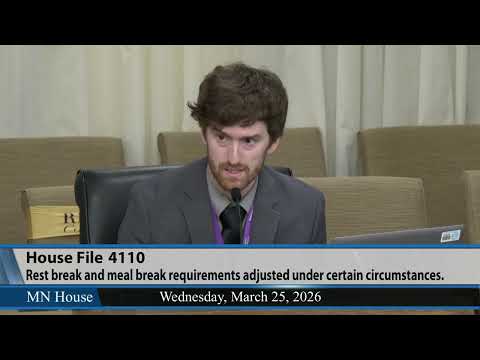
Representative Zeleznikar, the bill sponsor, told the House Workforce, Labor, Economic Development, Finance and Policy Committee that House File 4110 is a "common‑sense bill" to resolve operational uncertainty in community residential settings where a single staff person provides continuous care to vulnerable adults. She said the bill does not remove access to restroom use or meals but clarifies that standard scheduled rest and meal timing used in other workplaces "don't apply" when a lone caregiver must prioritize resident safety during emergencies.
The Department of Labor and Industry opposed the bill. Josiah more, the department's legislative director, said the 2025 statutory update created a new requirement for paid rest breaks (at least 15 minutes per four consecutive hours) and an expanded meal‑break rule (30 minutes when working six or more consecutive hours). He noted the law includes remedies for employees denied required breaks—payment for the break time plus liquidated damages—and said HF 4110 would remove those remedies for the covered situations.
Supporters from provider organizations said HF 4110 is narrowly tailored to protect residents while preserving practical staffing models. Khan dense, director of research, analysis and policy at an association representing licensed residential service providers, and witnesses from the Long‑Term Care Imperative argued many group homes routinely operate with one staff on shift and that staff are typically paid for the full shift and may take interrupted breaks later when safe to do so. They said the bill would allow caregivers to remain with residents during emergencies without penalizing providers when coverage cannot be provided.
Several committee members raised concerns about the breadth of the draft language and the removal of statutory remedies. Representative Pete Johnson asked whether the bill could unintentionally apply to hospitals or larger facilities; proponents replied the bill targets the ‘‘sole worker’’ scenario in small community residential settings and is not intended to affect staffed hospitals or large nursing homes.
On the roll call the author moved to place HF 4110 on the General Register. The clerk recorded 7 ayes and 6 nays; the motion did not carry and the bill was laid on the table for further consideration. The committee provided no final change to the statute at this hearing.
The committee did not adopt amendments on the record and no binding rule changes took effect at the meeting; the bill remains pending.