Get Full Government Meeting Transcripts, Videos, & Alerts Forever!
Get email alerts on the Nuclear Study topic
No spam. Unsubscribe anytime.
Broad support and an oral amendment as Senate committee advances nuclear study bill to finance review
Summary
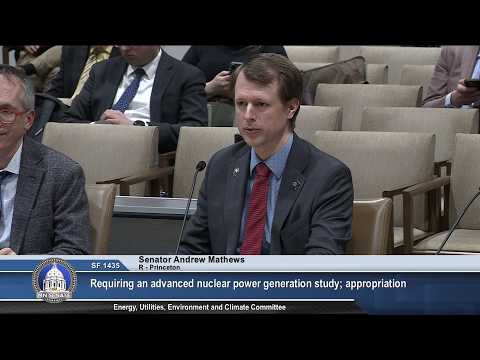
Senate File 14-35, a bill to study new nuclear deployment and lift Minnesota's moratorium, drew testimony from county officials, utilities, labor and environmental groups; the committee adopted an oral amendment changing a report deadline and laid the bill over for possible inclusion and finance review.
Senate File 14-35, presented by Senator Matthews, would authorize a study of new nuclear deployment and related issues, including geology suitability, workforce, spent-fuel management and potential economic impacts. The bill was described by proponents as a first step toward assessing options for carbon-free, continuous power in Minnesota.
Speakers included local officials from Sherburne County, the Minnesota Nuclear Energy Alliance, the Minnesota Rural Electric Association, labor representatives and environmental advocates. Greg Felder, speaking for local officials, said Sherburne County supports lifting the moratorium and hosting nuclear development. Derek Mole, president of the Minnesota Rural Electric Association, described broad and bipartisan stakeholder participation in an alliance working to lift the state moratorium. Eric Meyer, an environmental nonprofit director who testified, recommended removing a 300-megawatt capacity limit for small modular reactors from the study language to avoid inadvertently constraining the study's scope. Kevin Prentice of construction labor emphasized the workforce and economic opportunity. Supporters noted engagement by the Prairie Island Indian Community in developing the current language.
Committee members raised timing and scope questions. A date discrepancy in the draft prompted an oral amendment: senators replaced a June deadline with a January date for a study milestone; the amendment was adopted by voice and the author said the intent was to make the study available to the legislature in time for deliberations. Members also debated whether the bill should explicitly cap the study at 300 megawatts for small modular reactors; the author said the bill version before the committee did not include that cap and members agreed to continue discussion. The committee laid the measure over for possible inclusion and for referral to finance because the RDA may be used to pay for the study.