Get Full Government Meeting Transcripts, Videos, & Alerts Forever!
Get email alerts on the Gaming Regulation topic
No spam. Unsubscribe anytime.
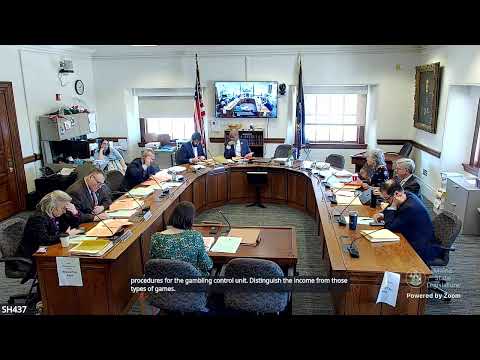
Committee hears fiscal briefing on LD1902 for electronic sealed‑ticket games; members seek clarity on staffing and remittance
Summary
Committee analysts summarized LD1902's fiscal estimates — including projections for license fees, terminal counts and revenue — and members questioned why the Gambling Control Unit appears in the fiscal note and how 5% transfers to the veterans homes stabilization fund will be collected and audited.
The committee reviewed the fiscal note and language changes for LD1902, a bill addressing electronic sealed‑ticket games, and asked staff to clarify key implementation and accounting questions before reporting action.
Analyst Rachel Olsen presented the minority fiscal report and read the committee’s revenue and cost estimates: license and application fees were "estimated to generate $128,500 in other special revenue funds revenue beginning in fiscal year 2627," with gross revenue estimated at $270,270 beginning in fiscal year 2627. The fiscal assumptions cited roughly 126 eligible organizations, up to 504 game terminals, an assumed $110 average gross per terminal per day across about 325 operating days, and two licensed distributors. Olsen also said the bill includes ongoing general‑fund appropriations of $55,050 for one public service manager and one auditor 2 position, ongoing other‑special‑revenue allocations of $5,997 for associated costs, and an allocation to the main veterans home stabilization fund reported in the transcript as $2,225,225 beginning in fiscal year 2627 (the transcript numbering/commas were inconsistent; staff committed to follow up with the fiscal office for confirmation).
Representative Anne Fredericks asked whether the Gambling Control Board participates in charitable gaming and why the Gambling Control Unit (GCU) appears in the fiscal note’s staffing and appropriations. Olsen said she would follow up with the fiscal office to clarify which accounts and staffing lines are implicated; she noted the executive director and the Gambling Control Unit share administrative elements under the Department of Public Safety, which may explain some accounting placements in the fiscal note.
Members pressed what entity will collect and remit the 5% allocation to the veterans home stabilization fund. A member relayed a conversation with Director Champion indicating that operators’ payments would flow to the state and the GCU would submit the 5% transfer, which in turn is why auditing and an auditor position appear in the fiscal estimate; Olsen said she would ask the fiscal office whether operators could remit the 5% directly to the veterans fund or whether centralized collection through the GCU is required by the bill’s drafting.
Representative Quentyn Chapman emphasized that the bill will not eliminate paper pull‑tab (paper sealed‑ticket) games: "This does nothing at all. It does not remove them. It doesn't phase them out." Olsen added that the bill does make modest changes to reporting and record‑keeping—such as requiring separate transactions and records per operator—that are intended to assist auditing but would not prevent patrons from buying pull tabs in the same manner as today.
Olsen also said the bill substitutes fingerprint‑based background check language (similar to language in prior bill 6009) for distributor licenses and adds corresponding Title 25 authorization under the State Bureau of Identification to facilitate FBI‑approved fingerprint processing.
Committee members asked several follow‑up questions and requested that Olsen and the fiscal office provide clarifications on (1) why the GCU staffing and appropriations are included, (2) whether operators can remit the 5% directly to the veterans fund or whether central collection is required, and (3) the exact allocations and multi‑year projections in the fiscal note. No formal committee action on LD1902 was recorded in the transcript; staff will report back with the requested fiscal clarifications.