Get Full Government Meeting Transcripts, Videos, & Alerts Forever!
Get email alerts on the Healthcare Prescribing topic
No spam. Unsubscribe anytime.
Committee hears strong support and safety concerns over proposed update to naturopathic formulary (LD2242)
Summary
The Health Coverage, Insurance and Financial Services Committee heard hours of testimony on LD2242, a resolve to allow final adoption of a provisional rule updating the naturopathic prescriptive formulary. Naturopathic doctors and patients urged approval to reduce delayed care; some physicians and pharmacists warned the committee about training, oversight and unregulated products.
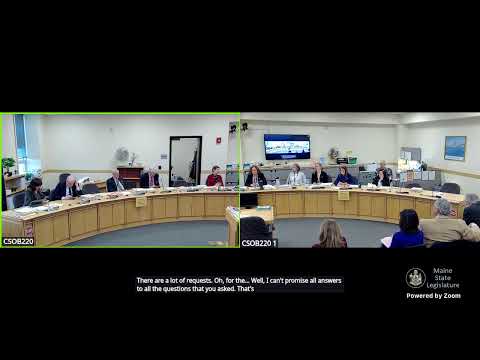
The Health Coverage, Insurance and Financial Services Committee opened a public hearing on LD2242, a resolve directing whether the Board of Complimentary Healthcare Providers may finally adopt a provisionally adopted major-substantive rule that modernizes the naturopathic prescriptive formulary.
Colleen McCarthy Reed, the committee analyst, told members that the resolve itself only authorizes final adoption of the provisional rule and cannot change statute. Penny Valancor, director of the Office of Professional and Occupational Regulation, testified she supported moving the provisional rule forward "as drafted without changes" and asked the committee to consider a separate statutory fix to streamline future updates. "I would like your support to move the provisional rule as drafted without changes," she said, and urged removing the statutory formulary subcommittee and allowing routine-technical rulemaking to avoid quorum-related delays.
Supporters — nearly all licensed naturopathic doctors and multiple patients — told the committee the existing formulary, written around 1996, is obsolete and has produced repeated patient delays and extra visits. Dr. Elizabeth Yori, identifying herself as a past president of the Maine Association of Naturopathic Doctors, said: "Under the current rules, many of the medicines used to manage common health care conditions are not accessible," and described cases in which patients had to wait weeks for care or be sent to urgent care because NDs could not prescribe frontline antibiotics or other routine therapies. She noted confusion about whether imaging with contrast could be ordered and called the rule changes "necessary clarity" for ambiguous provisions.
Supporters said the draft rule moves Maine to a clearer, exclusion-based formulary anchored to recognized drug classification systems so pharmacists and clinicians can know what is and is not permitted. Witnesses identified common additions they expect the new formulary to enable in practice: access to first-line antibiotics, metformin and other diabetes medicines, blood-pressure medications and clarified authority to order certain imaging studies — but they emphasized that controlled substances and most psychotherapeutic agents (with narrow exceptions cited in the packet) remain excluded.
Several clinicians described specific harms from the current formulary language: delayed antibiotics that preceded a ruptured eardrum, four-week waits to obtain an MRI with contrast, and patients sent to emergency departments for blood-pressure medication changes because NDs could not prescribe safe, routine antihypertensives. Testimony also urged continuing safeguards: initial supervised prescribing for newly licensed NDs and ongoing continuing education requirements.
Physicians, pharmacists and other health-care stakeholders testified with reservations or in opposition. Dr. Jane Pringle, a longtime internist and residency director, said she opposes the proposal on training grounds: "I do not believe that lowering training standards is the appropriate path forward," she testified, urging reliance on evidence-based systems and residency-level competency for complex prescribing. Garrett Fontaine, MD, for the Maine Medical Association and several allied groups, told the committee that MDs and DOs complete far more supervised clinical hours (including residency) than the clinical training now described for NDs and urged caution.
Other opponents flagged emerging markets and products they said require explicit limits and oversight. Dr. Amanda Cardella, DO, warned the committee that broad language allowing "peptides and amino acids" could enable use of non-FDA-approved or research-grade compounds if the statute or rule does not clearly limit such prescribing and compounding.
Where the proposal stands: LD2242 is a review resolve for a major-substantive rule. Committee staff emphasized that statutory changes must be pursued in a separate bill. The co-chairs closed the public hearing after hearing extensive oral testimony and requests for follow-up information (number of licensed naturopathic doctors, whether specific items are FDA-approved, and additional pharmacist review). The committee did not take a final vote on LD2242 at the hearing and will consider further action in work sessions.
Next steps: staff will provide the numeric and documentary follow-ups requested by members and the committee will determine a work-session schedule to consider the rule package, any proposed amendments to the resolve, and potential separate statutory language to address the governance concerns raised by OPOR.