Get Full Government Meeting Transcripts, Videos, & Alerts Forever!
Get email alerts on the SNAP And Child Services topic
No spam. Unsubscribe anytime.
Minnesota panel hears $2026 supplemental proposals to shore up SNAP payments, boost fraud prevention and modernize legacy systems
Summary
At a March 25 committee hearing, the Department of Children, Youth and Families outlined Governor's 2026 supplemental requests to cover a new state share of SNAP costs created by the federal reconciliation bill, strengthen fraud prevention in childcare assistance, and fund phased legacy‑system modernization and training expansions for local workers.
The Minnesota Senate Health and Human Services Finance and Policy Committee on March 25 heard the Department of Children, Youth and Families (DCYF) present the Governor's 2026 supplemental budget items aimed at protecting SNAP benefits, expanding program‑integrity capacity and beginning a phased modernization of the state's legacy eligibility systems.
The department's commissioner, identified in the record as Commissioner Brown, told the committee the package is designed to "protect SNAP for Minnesotans by paying this federally required...benefits" after changes in the 2025 federal budget reconciliation bill referred to in testimony as HR ONE. Commissioner Brown said the proposal would expand oversight and training, add real‑time case reviews to prevent payment errors and create a secure applicant portal to reduce eligibility errors.
Why it matters: federal changes to SNAP and Medicaid‑related rules will shift administrative burdens and some new costs to states; DCYF told the committee it is seeking resources to avoid service interruptions for vulnerable families and to reduce future state fiscal exposure by improving payment accuracy.
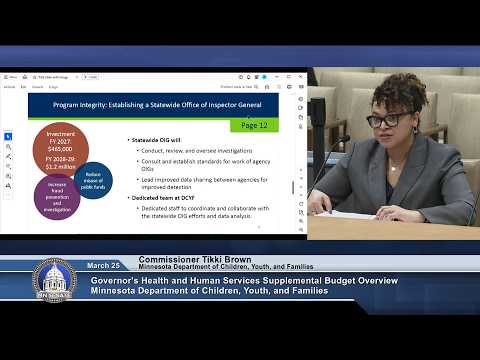
Details the agency gave include an initial SNAP proposal that the presenter described as "invest 2.1 million in fiscal year 2027" and a multi‑year figure listed in the presentation materials (transcript reference: "194.1 million in fiscal year 28‑29"). The department also outlined measures aimed at the child‑care assistance program: expanded investigative capacity with an investigator team, mandatory provider training for recipients of the child‑care assistance program and a single case‑management system for investigations. Commissioner Brown said the program‑integrity package would include grants for counties and tribal nations to increase investigative capacity.
During committee questioning, Sen. Graham and others pressed the agency on the legacy IT work. Commissioner Brown said DCYF has studied other states and plans a phased approach rather than an immediate full overhaul: "we have learned, I think, from some of their mistakes" and will use pilots and proof‑of‑concept testing with vendors to reduce risk. Ashley Rise, the department's chief financial officer, said DCYF's proposals include new FTEs—"25 in the SNAP proposal" and additional positions in other initiatives—and noted DCYF currently has "a little over 900 FTE[s]."
What the committee heard but did not decide: members repeatedly urged faster vendor testing and stronger county engagement so systems meet local needs; several senators emphasized the risk that short‑term fixes could harm people if long‑term modernization is delayed. No formal committee action on the DCYF items was recorded at this hearing.
Next steps: DCYF's presentation concluded with an offer to return for further discussion; committee members requested additional detail on procurement, pilot sites and county engagement before votes would be scheduled.