Get Full Government Meeting Transcripts, Videos, & Alerts Forever!
Get email alerts on the Campus Safety topic
No spam. Unsubscribe anytime.
House committee rejects bid to refer bill that would let public colleges bar visitors'with guns
Summary
A motion to refer House File 43‑62 — which would let public colleges decide whether to prohibit visitors from carrying firearms — failed on a 7–7 tie. Supporters said campuses should have authority to protect students; opponents warned of enforcement, due‑process and rights concerns.
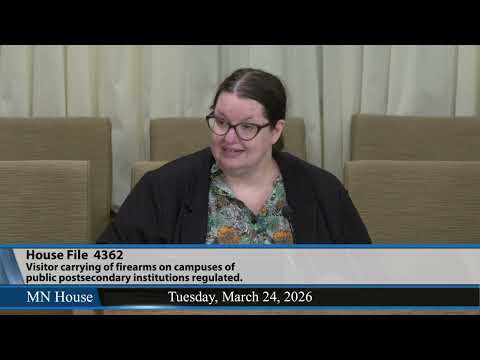
The House Higher Education Finance and Policy Committee on the laid‑over HF 43‑62 failed to refer the bill to Public Safety after a 7–7 tie on a motion to refer.
Vice chair culture, the bill's sponsor, told the committee the proposal would let Minnesota State and University of Minnesota campuses decide whether to extend existing prohibitions on students and employees to visitors. "I want you to think about someone who's starting their freshman year of college this fall," the vice chair said, arguing campuses should have "the power to make those decisions about how to protect staff, faculty, administrators and the nearly 400,000 students from gun violence." She emphasized the measure would grant discretion, not mandate campus bans.
Janet, identified in testimony as the president of the IFO and a Winona State sociology faculty member, told lawmakers that under current law public campuses cannot prohibit visitors carrying guns and cited national data suggesting many campus shootings involve nonaffiliated individuals. "When our faculty members are walking around campus and see that someone has a gun...there is no official action the university can take," she said, arguing the proposal fills a legal gap.
Witnesses opposing the bill included a National Rifle Association representative (appearing in the transcript as Brin Gosh) and a Minnesota Gun Owners Caucus representative (appearing as An Illini). The NRA witness said "putting up a sign or having a rule" does not disarm criminals and warned expanded restricted zones could create vulnerabilities for law‑abiding permit holders and due‑process problems where campus boundaries are unclear.
Committee members pressed on practical questions including enforcement, the bill's treatment of parking areas and whether private colleges receive state subsidies that make differences in authority worth revisiting. Representative Klevorn and other supporters framed the bill as a public‑safety and fiscal measure, saying preventing campus incidents reduces emergency response costs and protects vulnerable students.
After the clerk took a roll call, the chair announced the tally as seven yes and seven no; the motion to refer did not prevail and HF 43‑62 was not sent to Public Safety. The committee did not advance the underlying bill during the session and moved on to other agenda items.
The committee recorded testimony from both campus advocates and gun rights groups and discussed enforcement and boundary questions; members asked the sponsor and agency staff to provide clarifications in future sessions.
The committee laid over further consideration of HF 43‑62; no final policy change was enacted at this hearing.