Get Full Government Meeting Transcripts, Videos, & Alerts Forever!
Get email alerts on the Affordable Housing topic
No spam. Unsubscribe anytime.
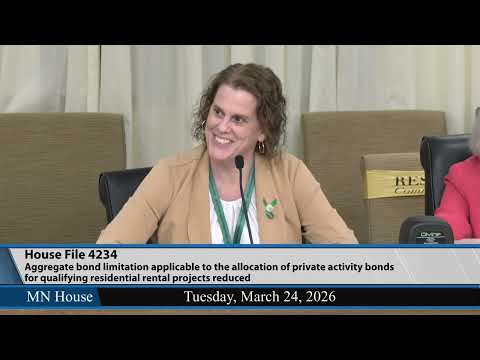
Committee hears bill to align Minnesota bond rules with federal change to boost affordable housing equity
Summary
An informational hearing on a bill to conform Minnesota’s private activity bond rules to recent federal changes drew support from housing advocates who said the fix could bring roughly $120 million in annual tax credit equity and increase the number of affordable projects in the state.
An informational hearing before the House Housing Finance and Policy Committee on a measure tracked in the transcript as House File 40 to 34 focused on changing Minnesota law so more projects can access federal low‑income housing tax credits.
Mary Tender Fall, who identified herself as a former commissioner of the Minnesota Housing Finance Agency and testified for the Greater Minnesota Housing Fund, told the committee the federal change (discussed in testimony as HR 1) lowers the share of project costs that must be financed with tax‑exempt private activity bonds to qualify for 4% tax credits. "We think that this simple change, we'll probably bring in additional 120 million dollars in tax credit equity into this state every year," she said, and estimated the change could increase projects funded in an average year from roughly 15 to about 24.
The bill would amend state limits so that the pool of federally allocated tax‑exempt bonds can be stretched across more projects without new state funds. Testimony explained the technical mechanics: federal law reduced the bond‑financing threshold on a project from the prior 50% level to as low as 25%, which changes how many projects can receive tax‑exempt bond allocations; if state statute does not mirror that change, some projects lose eligibility for 4% credits.
Committee members praised the proposal and the housing community consensus behind it. Co‑chair Howard and others said the bill is a technical alignment that could produce more public‑private investment in affordable housing at a time when state dollars are tight. No formal opposition was reported during the informational hearing.
The bill’s implementation was described in testimony as delayed to January 1 of the next year so developers with projects in process can modify applications. Advocates and developers supporting the bill include the Twin Cities Housing Alliance, the Family Housing Fund, the Minnesota Housing Partnership, the Greater Minnesota Housing Fund and other housing stakeholders.
The committee held the bill as an informational item during this hearing; no floor action was recorded in the transcript for this measure. Next procedural steps would depend on whether the sponsor brings the bill back for committee recommendation.