Get Full Government Meeting Transcripts, Videos, & Alerts Forever!
Get email alerts on the Tax Incidence Study topic
No spam. Unsubscribe anytime.
Department of Revenue presents tax‑incidence study: Minnesota’s state and local tax system near proportional but slightly regressive
Summary
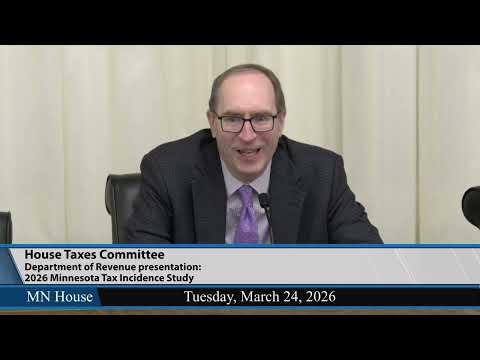
Department of Revenue director of tax research Eric will let told the House Tax Committee the 2026 tax‑incidence study (base year 2023) finds Minnesota’s state and local tax system is close to proportional on average but a bit regressive, with large refundable credits reducing burdens for low‑income households.
Eric will let, director of tax research at the Minnesota Department of Revenue, presented the Department’s 2026 tax‑incidence study to the House Tax Committee, using tax‑year‑2023 data and projecting the system forward to 2028 under enacted law.
The study creates a household database that includes income‑tax filers and non‑filers and attributes all state and local taxes to households and businesses. "We estimate that about 15.6% of all state and local taxes in 2023 were exported to taxpayers who are not Minnesotans," Eric will let told the committee during the presentation.
Why it matters: the study is the Department’s most comprehensive look at who ultimately bears Minnesota’s state and local tax burden and is intended to inform lawmakers weighing tax changes. It compares the distribution of taxes across ten population deciles and reports both effective tax rates and a Suits index—a standard measure of progressivity.
Key findings and context
- Distribution and the Suits index: On average the system is very near proportional. The Department reported a Suits index slightly below zero, indicating a small net regressive tilt overall, while noting year‑to‑year volatility.
- First (lowest) decile: The lowest decile shows a notably high effective tax rate (the presenter reported 36.6% for that decile), but the Department cautioned that this figure is sensitive to measurement choices. Will let said the number reflects temporarily low cash incomes for some households, negative business income for others, and the study’s exclusion of in‑kind assistance (housing, SNAP, medical assistance), which would lower measured effective rates if included.
- Taxes by type: Personal income tax is the largest revenue source and is the most progressive component in dollar and percent‑of‑income terms; sales and many local taxes are regressive. Refundable credits and property‑tax refund programs (including the child tax credit and renter/homeowner refunds) are among the most progressive policy instruments in the state tax code and substantially reduce burdens for lower‑income households.
- Policy changes and projections: The Department incorporated 2023 law changes (for example, the child tax credit expansion and the conversion of a renter refund to an income‑tax form) and economic forecasts into projections to 2028. Under the Department’s projection assumptions the overall Suits index changes little by 2028, though specific deciles see modest shifts driven largely by income and consumption patterns.
Select exchanges with committee members
Committee members asked about the large change in the first decile since the prior study. Will let said much of the difference reflects changes in incomes between the pandemic year (2021) and 2023—pandemic‑era federal payments and higher unemployment receipts inflated incomes in 2021, which then fell by around a third in the lowest decile by 2023. Members also pressed on vehicle‑registration tax incidence and rental‑property taxes; the presenter explained the empirical approach and noted the team can hard‑match vehicle purchase and tax records for confident estimates.
What’s next
The Department left corrected slides and supplementary tables for the committee and said it can provide further breakdowns on specific questions (for example, approximate dollar impacts of the 2023 package on households and estimates that include the value of in‑kind assistance). The committee moved on to other agenda items after a short discussion and thanked Department staff for the work.
Sources: presentation to the House Tax Committee by Eric will let, director of tax research, Minnesota Department of Revenue; Department tax‑incidence study (presentation slides and report cited during hearing).