Get Full Government Meeting Transcripts, Videos, & Alerts Forever!
Get email alerts on the Driver Id Speech Condition topic
No spam. Unsubscribe anytime.
Committee lays over bill allowing optional speech-condition notation on IDs after testimony
Summary
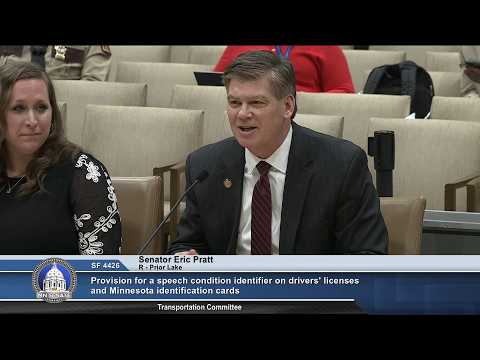
Senate File 44,26, which would permit a nonmedical designation for speech conditions (example: stuttering) on driver's licenses and IDs, was laid over for possible inclusion after testimony from speech professionals and affected people and agency questions about a roughly $141,000 one-time implementation cost.
A bipartisan bill to permit an optional, nonmedical notation that a person has a speech condition on driver’s licenses and identification cards was laid over for possible inclusion after broad supportive testimony and agency questions about costs and timing.
Sponsor testimony and three witnesses — including a speech-language pathologist and people who stutter — described traffic stops and other high-pressure interactions that can produce or amplify stuttering and said a simple notation would reduce misunderstandings and the risk of escalation. Speech-language pathologist Brianna Moore testified that roughly 87,000 Minnesotans stutter and that a discreet identifier can give law enforcement immediate context during time-sensitive encounters.
Driver and Vehicle Services staff and fiscal analysts said the change requires a vendor programming amendment and template changes for cards and provided a one-time estimated implementation cost of about $141,000, mostly for a vendor contract amendment and application changes. Department staff recommended allowing adequate lead time for vendor updates and suggested a later effective date to accommodate printing and programming timelines.
Committee action: Members agreed to lay the bill over for possible inclusion so staff can work with the agency on programming timelines, effective dates and whether the agency can absorb some or all implementation costs.
Attributions in this article use the names and roles recorded in the committee transcript.