Get Full Government Meeting Transcripts, Videos, & Alerts Forever!
Get email alerts on the Paraquat Ban topic
No spam. Unsubscribe anytime.
Minnesota Senate committee hears testimony on bill to ban paraquat
Summary
A Minnesota Senate Agriculture Committee hearing on Senate File 41‑60 drew testimony from people with Parkinson’s, public-health advocates and farm-industry representatives over whether to prohibit sale and use of the herbicide paraquat; the bill was laid over for further work.
A Minnesota Senate Agriculture Committee hearing on March 23 heard competing testimony over a bill that would prohibit the sale and use of the herbicide paraquat in Minnesota.
The committee considered Senate File 41‑60 after the bill’s sponsor described paraquat as an “acutely toxic” herbicide and cited research linking exposure to Parkinson’s disease. Several Minnesotans with Parkinson’s, including Lisa Erickson and Lynn Johnson, testified about their diagnoses and urged lawmakers to ban the chemical to prevent further illness.
"Parkinson’s is a cruel progressive brain disease that slowly takes your independence," Lisa Erickson told the committee, describing an early retirement prompted by her diagnosis. A representative for the Michael J. Fox Foundation summarized national data and research linking paraquat exposure to higher risk of disease and said more than 21,000 Minnesotans live with Parkinson’s.
Industry witnesses and crop-retailer representatives pushed back. Mr. Held, an executive director for crop retailers, told senators paraquat is a restricted‑use product applied by trained, licensed applicators and that the U.S. Environmental Protection Agency has previously reviewed the product’s safety. "The EPA found that the weight of the evidence was insufficient to support a causal association," Mr. Held said.
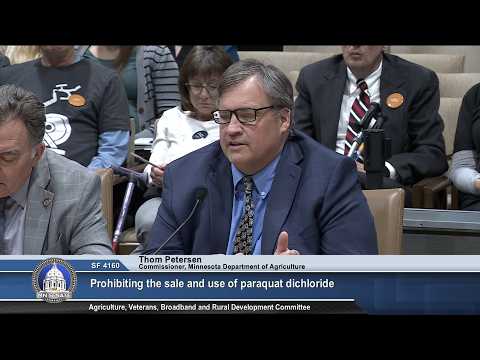
State agricultural officials, including Commissioner Thom Petersen, said the Minnesota Department of Agriculture had not taken a formal position and pointed to technical issues in the bill, including timing for a ban, handling of existing stocks and waste-disposal logistics. Department staff said the state’s waste-pesticide program can accept unused product and described processes used to neutralize and incinerate hazardous pesticide wastes.
Committee members asked detailed questions about crop uses, whether paraquat residues enter food, the product’s role in terminating cover crops and alternatives to chemical termination, and how unused product is collected and destroyed. One agency witness said EPA modeling showed paraquat could travel miles from application sites in some conditions.
After several hours of testimony and questioning, members said they would lay the bill over for further discussion and possible inclusion in broader agriculture policy work. No committee vote was taken at the hearing.
The committee is expected to continue discussion on the bill and related pesticide and agriculture policy items in upcoming meetings.