Get Full Government Meeting Transcripts, Videos, & Alerts Forever!
Get email alerts on the Agriculture topic
No spam. Unsubscribe anytime.
Proposal to make ammonia in Minnesota draws broad industry support; bill laid over
Summary
Senate File 17,10 (Minnesota Made Ammonia Act) drew testimony from farmer cooperatives, clean‑energy registries and research centers arguing locally produced ammonia—paired with curtailed wind power—could stabilize fertilizer prices. The committee laid the bill over for possible inclusion.
Senate File 17,10, the "Minnesota Made Ammonia Act," drew multiple supporters who said domestic production of ammonia paired with renewable electricity could reduce price volatility for farmers and keep economic value in Minnesota.
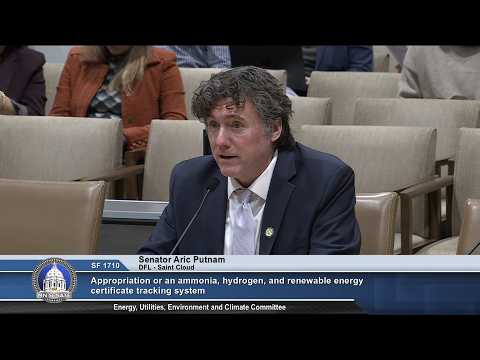
Senator Eric Putnam, the bill’s chief author, said recent global price swings and supply‑chain disruptions have made fertilizer both expensive and uncertain for Minnesota farmers; he presented the bill as a way to expand local manufacturing that leverages renewable energy and curtailed wind. Casey Greener, chief executive officer of Central Farm Service, testified: "Farmers don't just have a price problem. They have supply uncertainty problems," and said a 10‑year fixed‑price contract for locally produced anhydrous ammonia would give farmers planning certainty and deliver an estimated $62 million in direct affordability benefits over 10 years.
Rob Davis of Clean Counts described the organization’s plan to track ammonia production so each unit can be auditable, a feature sponsors say is needed to build market trust as the model scales. Rachel Stuckey (Minnesota Conservative Energy Forum) and other coalition partners emphasized cross‑sector benefits: local production could use otherwise curtailed wind energy, support manufacturing and mining, and keep tax revenue in rural counties that host turbines.
Committee members pressed sponsors on scope and specifics: whether the bill prioritizes Minnesota farmers, the inclusion of renewable tracking language, and why certain appropriations (including grants to the Great Plains Institute and the University of Minnesota) were included. Mike Reese of the West Central Research and Outreach Center explained that ‘‘green’’ ammonia is a commonly used label for domestically produced ammonia paired with low‑carbon electricity and clarified that ‘‘curtailed power’’ refers to excess generation that cannot be delivered through the grid.
An author's amendment and a subsequent oral amendment removing a $10,000 line item for Commerce were adopted. The committee did not take a final vote to pass the bill; Senator Putnam closed by asking members to consider the bill’s potential to stabilize input costs for farmers. SF 17,10 was laid over for possible inclusion later in the session.
Next steps: the bill remains under consideration; sponsors and agencies indicated further refinements (priority language for Minnesota purchasers and funding allocations) may be explored in subsequent negotiations.