Get Full Government Meeting Transcripts, Videos, & Alerts Forever!
Get email alerts on the Environment Wildlife topic
No spam. Unsubscribe anytime.
Committee backs major rule aligning vernal‑pool protections and endangered‑species habitat with recent law
Summary
The committee provisionally adopted LD2240, a resolve to review a major substantive rule that updates chapter 10 to extend significant vernal‑pool protections onto abutting properties when the 250‑ft consultation zone drapes over a neighbor, introduces a 100‑ft 'tier 1' envelope with stricter review, and creates a mechanism for IFW to consult with DEP on endangered and threatened species habitat.
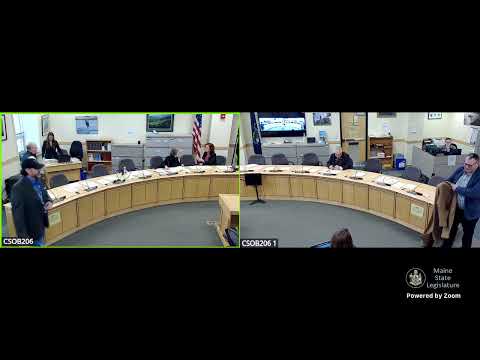
The Inland Fisheries and Wildlife Committee on March 1 provisionally adopted LD2240, a legislative review of a major substantive rule that amends the department's chapter 10 rules for significant wildlife habitat.
Philip Demay Nadier, wildlife diversity program manager for the Department of Inland Fisheries and Wildlife, said the rulemaking implements statutory changes enacted in Public Law 2023, chapter 156 (which expanded the definition of significant wildlife habitat to include state endangered and threatened species) and Public Law 2025, chapter 338 (which revised protections for certain high‑value vernal pools). "Maine is home to over 16,000 species of inland wildlife, of which 57 are currently listed as state endangered or threatened," he told the committee, framing habitat loss—especially from development—as the most important threat.
What the rule does
- Vernal‑pool envelope and adjoining parcels: Under the revised chapter 10, the 250‑foot consultation zone measured from the pool's high‑water mark will no longer terminate at the pool owner's property line in cases where that 250‑foot zone drapes onto an adjacent parcel. The updated rule would subject both the pool owner and the abutting landowner to consultation requirements for the full zone.
- 100‑ft 'tier 1' zone: The package includes stricter review thresholds within the 100‑foot band nearest the pool (described as a tier‑one envelope). Activities within that band would not be eligible for streamlined permit‑by‑rule notifications and would instead require more detailed review or a full permit process, though not an absolute prohibition on development.
- Endangered and threatened species habitat: Chapter 10 would now explicitly implement protections for state‑listed endangered and threatened species by enabling departmental consultation during NERPA (Natural Resources Protection Act) permit reviews; IFW said it expects to map only a subset of the 57 state‑listed species for this regulatory purpose where habitat is vulnerable to land‑use conversion.
Committee concerns and practical effects
Members pressed staff on how the 250‑foot and 100‑foot measurements are made (from the vernal pool's high‑water mark, using soils, topography and vegetation indicators) and on how significant pools are designated (triggers include presence of certain fairy shrimp, egg‑mass thresholds for salamanders, or endangered species sightings). IFW and conservation witnesses emphasized that significant vernal pools represent a small fraction of all pools and that designation typically relies on landowner permission and scientific evidence.
"This rulemaking implements these statutory changes by amending chapter 10 to align with current statutory requirements," Demay Nadier said, stressing interagency coordination with the Department of Environmental Protection.
Mitigation and property impacts
Witnesses and members discussed mitigation options (in‑lieu fees, directional buffers, larger culverts and other engineering measures) and whether landowners would be foreclosed from development. Staff and conservation advocates said rules provide mitigation pathways—permits, buffers, engineered crossings and fee‑based mitigation—rather than absolute bans, but acknowledged that some site plans would need adjustment and that the changes could affect permitting timelines.
Committee action
After deliberation, the committee voted to accept the major substantive rule package and to send a majority report. The roll call showed seven votes in favor (Kluchi, Terry, Dill, Roberts, Garren, Bridgio, Reynolds) and three opposed (Lance, Thorne, Mason). Committee staff noted the rule's implementation is timed to align with DEP rule changes and that judiciary review remains pending for final enactment.
Next steps
The rule advances under legislative review as a late‑filed major substantive rule. Committee members asked for clarifications on mapping protocols, removal criteria for pools that cease to function, and public‑notice processes; staff recommended follow‑up in work sessions as DEP and IFW finalize parallel rules.