Get Full Government Meeting Transcripts, Videos, & Alerts Forever!
Get email alerts on the Public Records topic
No spam. Unsubscribe anytime.
Maine IFW bill would tighten confidentiality for license data, clarify what counts as personal information
Summary
The Inland Fisheries and Wildlife Department backed LD2236 to let the agency broadly keep license‑holder emails confidential, clarify definitions of personally identifiable information and data, create fee rules for large records requests, and mirror crash‑report exemptions for ATVs and snowmobiles. The committee approved a majority report with an amendment to explicitly allow release of names and mailing addresses for licenses.
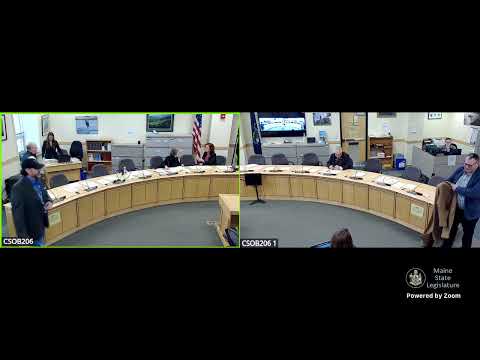
A Maine legislative committee on March 1 heard and advanced a Department of Inland Fisheries and Wildlife bill, LD2236, that would change how the agency handles public‑records requests for license and crash‑report databases.
Crystal Tero of the Department of Inland Fisheries and Wildlife told the Inland Fisheries and Wildlife Committee the measure stems from a working group convened under 2025 resolve to examine classification and access to IFW records. The bill would, among other changes, repeal a provision that let applicants mark their email address confidential, instead permitting the department to treat email addresses as confidential across the board and to define more clearly what counts as personally identifiable information (PII) in databases.
"The purpose of the FO law was at the center of the discussions to provide transparency and accountability within government operations and to build public trust," Tero said, adding that the working group sought a balance between transparency and protecting license‑holder privacy. She told the committee IFW had submitted suggested edits because the printed bill contained formatting differences and omissions from their draft.
Why it matters: IFW collects names, addresses, license numbers, email addresses and other details from hunters, trappers, guides and commercial licensees. The bill aims to prevent bulk releases of PII that could be used for commercial marketing while preserving public access to non‑identifiable statistical data. It also would let IFW set fee schedules and work with Inform, a records‑processing entity, to charge per‑record or flat fees for large requests.
Key provisions and committee concerns
- Definitions and scope: The bill adds definitions for "data," "commercial record" and "non‑commercial record," and distinguishes what PII must be held confidential in each case. IFW requested edits to ensure definitions cover paper as well as electronic records and databases.
- Email confidentiality: Instead of keeping an opt‑out checkbox for email addresses, IFW proposed treating emails confidentially by default because the opt‑out was difficult to administer.
- Names, mailing addresses and the moose lottery: Committee members pressed whether traditional public lists—such as the moose lottery and antlerless deer permit lists—would still be available. IFW said names and mailing addresses for those specific lotteries could be made releasable in non‑PII extracts, while other contact details (phone numbers, physical addresses, email) would generally be withheld. During the work session Representative Sally Kluchi moved to add explicit language stating the department "may publicly disseminate names and mailing addresses with any license, permit, or registration the department holds." That amendment was adopted as part of the committee's majority report.
- ATV and snowmobile crash reporting: Sections 3 and 4 mirror Maine State Police crash‑report exemptions by permitting release of non‑PII ATV and snowmobile accident data, letting IFW charge fees for data processing and restricting release of registration numbers without affidavit protections.
- Fees and Inform: The bill would let IFW set fee schedules by rule and work with Inform to process high‑volume requests; IFW representatives said that approach would speed public access and reduce staff burden.
Committee action
After a brief caucus, the committee voted on a motion that LD2236 "ought to pass as amended," incorporating IFW's suggested edits and the explicit names‑and‑mailing‑address sentence. The roll call recorded seven votes in favor (Kluchi, Terry, Dill, Garren, Bridgio, Reynolds, Roberts) and three opposed (Lance, Thorne, Mason). The committee approved a majority report and noted a minority report was filed by the no votes; the measure is slated for further review by the Judiciary Committee.
What remains unresolved
Committee members asked IFW to confirm precise lists of PII fields and to clarify the mechanics for distinguishing mailing and physical addresses in the statute text. Lawmakers also pressed whether a targeted opt‑out (for congratulatory mailings) could be implemented; IFW said that would require licensing‑system changes and preferred to pursue a work session to refine implementation details.
The committee moved LD2236 forward with the understanding that language and implementation details would be worked through before final passage in subsequent committee reviews.