Get Full Government Meeting Transcripts, Videos, & Alerts Forever!
Get email alerts on the Legacy Grants topic
No spam. Unsubscribe anytime.
Minnesota Humanities Center tells Legacy Committee most grants launched as demand far outstrips funds
Summary
At a Legacy Committee hearing, the Minnesota Humanities Center reported that most of last session’s legacy appropriations have been launched and awarded, but application demand — especially for festivals and ethnic media — far exceeded available dollars; some grant lines remain to be launched in year two.
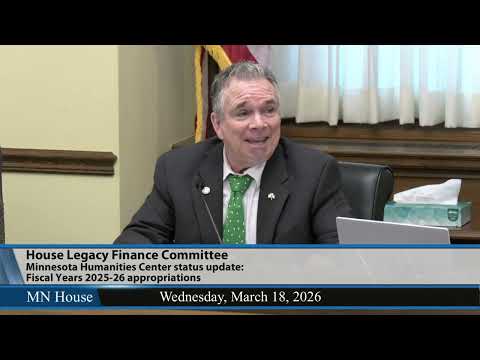
The Minnesota House Legacy Committee heard on the floor that most of the legacy grant dollars it appropriated in the last session have been launched and awarded, but that demand across several grant categories far exceeded available funding.
Kevin Lindsay, chief executive officer of the Minnesota Humanities Center, and Trustee Auger, director of grants administration, told the committee during a March meeting that MHC used a two‑year application window so organizations could apply for year one, year two or both, and that approach was intended to reduce administrative burden for applicants. “Most of the grant funding that this committee provided … has been launched, [and] were awarded,” Lindsay said.
The presenters described a three‑stage review: an initial eligibility check, review panels recruited for each grant line, and a final “pruning” stage in which MHC may limit awards based on financial capacity or statutory eligibility. Trustee Auger said MHC emphasizes applicant support — informational sessions, one‑on‑one meetings and draft application reviews — to help smaller organizations comply with Minnesota law and the Department of Administration’s grants rules.
MHC gave line‑level figures that show high competition: festival grants drew 141 applications; museum exhibits and collections drew 54; cultural heritage applications remained high and stable; and the newly created ethnic media line closed with 69 applicants requesting roughly $3.9 million while only $500,000 was available. MHC also said the emergency response grant rejection rate is about 71 percent, while rejection rates for festival and museum lines were closer to 15 percent and cultural heritage just under 9 percent.
Lindsay told members that MHC will complete and execute the remaining grant agreements before the next legislative session and that award notifications for some lines are expected within weeks. He also said MHC can provide the Legislature with a list of awardees and will meet one‑on‑one with organizations that request feedback from review panels.
Committee members pressed MHC on several points, including whether priority organizations had been told they needed a 50/50 match to qualify (Lindsay said there is no statutory match requirement); how review panels are selected (MHC recruits panelists based on criteria tied to each grant line, such as geography, media background, veteran status, and efforts to avoid conflicts of interest); and why some priority organizations submitted thin applications despite their designation. Lindsay said priority status does not guarantee funding and that some priority organizations submitted weaker applications, which was reflected in panel scores.
Several members praised MHC’s outreach and said they appreciated the organization’s effort to get dollars into the field more quickly than in the prior biennium. MHC also described sample programming funded by legacy grants — including a Native American Lives book series intended for schools and libraries, language‑revitalization symposiums with tribal partners, rural touring performances, and cultural food and music events — as evidence of statewide reach.
The committee closed the update by asking MHC to provide additional details as requested by members, including lists of awardees (already provided to the Legislature) and one‑on‑one feedback to unsuccessful applicants who request it. MHC said it will finalize recommendations and agreements for some lines within weeks and launch remaining year‑two opportunities after July 1, as permitted by the enabling language.
Next procedural step: the committee moved on to other business; MHC will return materials and award lists to legislators and follow up with offices that requested more information.