Get Full Government Meeting Transcripts, Videos, & Alerts Forever!
Get email alerts on the Assisted Living Safety topic
No spam. Unsubscribe anytime.
Human Services committee hears testimony on assisted-living safety; adopts amendment and lays bills over
Summary
After testimony about a resident death, the committee adopted an A1 amendment narrowing assisted‑living response rules to medical emergencies, removed a proposed fine, and laid over multiple assisted‑living consumer‑protection bills (including required AED access and call‑log transparency) for further negotiation and potential inclusion.
A Minnesota House Human Services Finance and Policy Committee hearing on March 17, 2026 produced intense testimony and an initial set of changes to assisted‑living rules after a family’s account of a fatal incident.
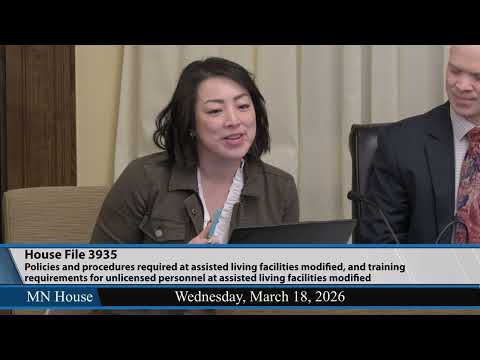
The committee adopted an A1 amendment that, according to the bill’s sponsor, narrows the proposal to address medical emergencies, clarifies which staff qualifications apply and removes a civil fine the members had questioned. The sponsor described the measure as "human‑centered," saying it focuses on facility policies and training for unlicensed staff so residents can receive timely assistance when medically necessary.
Why it matters: witnesses and family members told the committee that a blanket “no‑lift/no‑touch” policy can leave residents at risk. Adrian Sloan, who identified himself as the son of the late resident Larry Thompson, described video and a timeline in which staff did not immediately call 9‑1‑1 after his father’s fall and urged lawmakers to prevent similar tragedies. "My father, Larry Thompson, was at an assisted living where he unfortunately passed away due to the no‑lift policy," Sloan said during testimony.
Advocates and regulators who supported the bills said the changes will promote consumer transparency and clarify expectations for prospective residents. Erin Huber of the Long‑Term Care Imperative and other provider representatives said they are committed to resident safety but warned that training, equipment and certification requirements could create significant costs and operational challenges — especially in rural facilities. Industry witnesses noted existing workforce shortages and turnover and asked for continued negotiation on training scope and implementation.
Members pressed on enforcement and compliance: witnesses said Minnesota Department of Health surveys and existing assisted‑living statutory provisions would be the likely venue for compliance checks, and testified that some training modules cited by proponents run about 40 hours and cost about $895 per person in the market samples they reviewed.
The committee also heard a separate consumer‑protection bill (HF 22 16) that would require AEDs in assisted‑living buildings, prohibit facilities from conditioning admission on obtaining a guardian, require MDH survey and corrective‑action posting for three years, and require facilities to keep logs of resident calls for help and response times. The Office of the Long‑Term Care Ombudsman supported that bill, calling it a transparency and safety improvement.
Outcome and next steps: lawmakers adopted the A1 amendment to the emergency‑response bill and, following the hearing and debate, laid the assisted‑living bills over for possible inclusion. Sponsors and stakeholder groups said they will continue negotiating technical fixes and implementation details — including potential grant or rate mechanisms to offset equipment and training costs — before the committee resumes deliberations.
What was not decided: no final funding mechanism or enforceable statewide timetable for equipment purchases or training was adopted; several provider groups warned of unfunded mandates and asked the Legislature to consider grants or rate adjustments. Members also debated the boundaries of guardianship protections and how to balance resident autonomy with clinical safety.
The committee plans follow‑up sessions for deeper review and additional public testimony before any of the measures move out of committee.