Get Full Government Meeting Transcripts, Videos, & Alerts Forever!
Get email alerts on the Autonomous Vehicles topic
No spam. Unsubscribe anytime.
Senate transportation committee advances commercial‑vehicle measure, hears wide testimony on autonomous‑vehicle package
Summary
The Minnesota Senate Transportation Committee on March 18 heard several competing bills on autonomous vehicles and moved a commercial‑vehicle measure (Senate File 40‑14) to the Judiciary Committee while holding or laying over other bills for more work. Testimony highlighted safety, accessibility, local control and workforce concerns.
The Minnesota Senate Transportation Committee heard hours of testimony on March 18 about four bills that would regulate driverless and automated vehicles in the state, advancing one commercial‑vehicle measure and leaving others for further work.
Senator McEwen moved that Senate File 40‑14, which would require a human driver in vehicles with a gross vehicle weight over 10,000 pounds and includes a sunset provision, be recommended to pass and be referred to the Senate Judiciary Committee; the committee carried the motion by voice. Senator McEwen said the bill ‘‘requires a human driver with the proper class of license to be physically present behind the wheel’’ of heavy commercial vehicles.
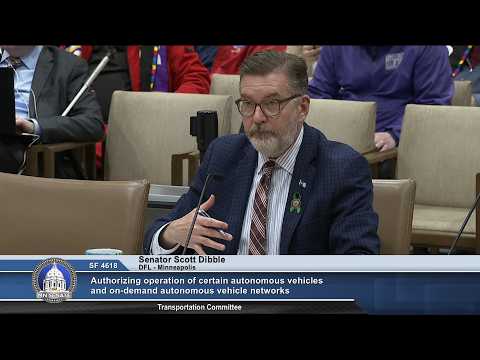
Authors and agency witnesses described competing policy choices. Senator Double — author of Senate File 46‑18, a broad framework bill — told the committee the legislation ‘‘establishes a comprehensive statewide framework for autonomous vehicle deployment that requires demonstrated safety and readiness, especially for Minnesota conditions’’ and emphasized provisions including first‑responder interaction plans, third‑party safety verification and a requirement that operators bear infrastructure costs they impose on the public. Senator Johnson Stewart presented Senate File 40‑10 as a separate, statewide regulatory approach focused on consistent permitting, minimal‑risk/fail‑safe requirements and clarified liability when no human driver is present.
MnDOT Commissioner Nancy Kopp told the committee MnDOT and the Governor’s Council on Connected and Automated Vehicles have recommended registration and permit systems, first‑responder interaction plans and third‑party safety verification, and she said the agency seeks to ‘‘ensure safety on our roadways while helping Minnesota realize the potential benefits of automated vehicles.’'
The hearing drew extensive public testimony with sharply different priorities: - Labor and transit unions urged caution and protections for workers, arguing the technology can displace drivers and that human operators provide safety‑critical judgment. David Stickers of the Amalgamated Transit Union said operators ‘‘are not just drivers’’ and cited roles such as responding to onboard medical emergencies. - Trucking and business groups supported phased pilots and clear statewide rules to attract investment but cautioned about insurance and liability cost pressures. A Minnesota Trucking Association representative backed testing and a phased approach while urging manageable insurance and certification requirements. - Disability and access advocates urged strong accessibility requirements and commitments to wheelchair‑accessible vehicles; Corey O’Connor of the National Federation of the Blind of Minnesota said operators entering the market must provide apps and in‑car interfaces that “are usable by the blind community.” Cole Davies, who said he cannot drive because of seizures, told the committee autonomous passenger vehicles would give him independence and asked lawmakers not to let one company’s problems derail broader access. - Environmental and street‑planning groups cautioned that on‑demand fleets could increase vehicle miles travelled and congestion unless policies require electric fleets, curb management and data sharing. - Industry representatives, including remote testimony from Laurie Daley of Waymo, urged adoption of a clear regulatory framework. Waymo cited company safety data and said the system has been tested in cold weather and would be taken out of service under extreme conditions; committee members pressed for specifics about how weather thresholds would be handled.
What the committee did - Senate File 40‑14 (commercial motor vehicles): Motion carried to recommend passage and refer to the Judiciary Committee (voice vote). The committee recorded an oral 'aye' vote but did not enter roll‑call tallies in the transcript. - Senate File 46‑18 (comprehensive): Held for further discussion; author indicated he would take amendments and return with a vehicle bill for markup. - Senate File 40‑10 and Senate File 43‑81: Presented and discussed; authors and witnesses indicated ongoing amendments and study work; both were laid over for additional committee consideration.
Why it matters Lawmakers and stakeholders framed the policy choices as tradeoffs between mobility and accessibility gains for people who cannot drive versus risks to safety, local control, public infrastructure and currently employed drivers. Several senators said they want to preserve local governments’ ability to manage curb access and street operations while others warned against overburdening companies to the point of deterring beneficial deployments.
Next steps Committee staff said they will return with draft amendments reflecting testimony; senators signaled more hearings and a markup day will follow as the package is refined before any floor consideration.