Get Full Government Meeting Transcripts, Videos, & Alerts Forever!
Get email alerts on the Supportive Housing topic
No spam. Unsubscribe anytime.
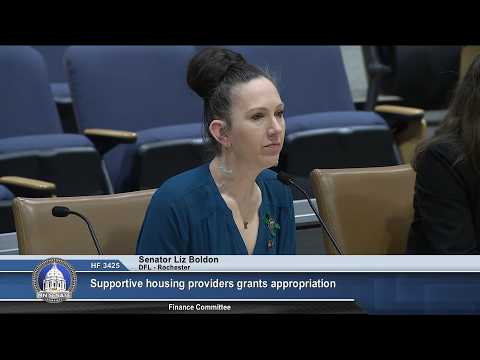
Senate Finance Committee recommends passage of bill to redirect state funds to supportive-housing providers
Summary
The Minnesota Senate Finance Committee voted to recommend House File 3425, a bipartisan measure to expand and redirect existing state supportive-housing funds to help providers weather federal funding cuts; the committee debated eligibility, regional allocation, interest earnings on the fund and reporting/audit safeguards before advancing the bill by voice vote.
St. Paul — The Minnesota Senate Finance Committee on Thursday recommended passage of House File 3425, a bill to expand the state’s use of an existing supportive-housing fund and provide temporary grants to providers facing cuts from the federal Continuum of Care program.
The sponsor told the committee the bill is budget-neutral and intended as a temporary measure to keep providers operating while longer-term funding solutions are developed. "This timely bill brings financial assistance to supportive housing providers so they will be able to keep their doors open," the sponsor said, adding the change would allow providers to receive grants that temporarily backfilled federal cuts.
Committee members pressed officials on who would be prioritized for aid and how that priority is determined. Christine Davis, executive director of Hearth Connection, said eligibility is guided by federal Continuum of Care rules and locally run assessment processes that prioritize people with verified disabilities and chronic homelessness. "If these funds disappear, people who are housed will become homeless in greater Minnesota," Davis told the committee.
Members also sought regional breakdowns of projects, beds and awards. Nonpartisan staff said project counts are roughly split between metro and greater Minnesota but cautioned that unit and bed counts can vary widely by project; staff offered to provide a ZIP-code–level breakdown to the committee.
Questions about financial controls and oversight were a key focus. Senators asked how the state would prevent fraud or misappropriation as dollars flow through Minnesota Housing. Ryan, assistant commissioner for policy at Minnesota Housing, described several safeguards the agency will use: grantees must submit documentation about their finances, enter formal grant agreements with detailed budgets, seek reimbursement with supporting claims that the agency will review during disbursement, and participate in grant close-out reconciliations. The bill also requires reporting to the commissioner on the use of grant funds and the number of people served, and staff said the commissioner compiles a final report to the Legislature. Agency staff said reporting would occur every 90 days until the funding expires.
The committee heard fiscal-history details from staff: a $25 million 2023 appropriation for supportive housing was reduced by legislative action in 2024 to $10 million; staff reported roughly $9.2 million remains available in the account (a figure discussed in committee as "9.2 million" and described by staff as not including accrued interest). Senators noted the fund has also earned interest — discussed in committee as roughly $1.1–$1.2 million — and questioned whether interest earnings had been used consistent with the Legislature’s intent.
Several members expressed frustration that one-time state dollars have been used to address ongoing needs and questioned the agency’s pace and priorities in deploying earlier appropriations. Agency representatives said much of the agency’s recent work has focused on recapitalization and on establishing a new permanent-supportive-housing program created by statute; they said some funds remain committed to those capital projects and that other resources are being readied for the program discussed in the bill.
In closing remarks the sponsor emphasized urgency, saying roughly "3,600 Minnesotans currently depend on this program" and arguing the bill represents a bipartisan way to prevent homelessness as federal funding shifts. Senator Sarah Muhammad moved the bill; the motion was seconded and the committee recommended House File 3425 be passed by the Senate by voice vote. The committee record shows a voice vote and the chair announced that the motion prevailed; no roll-call tally was recorded in the hearing transcript.
The measure will now proceed to the Senate floor under the committee’s recommendation.