Get Full Government Meeting Transcripts, Videos, & Alerts Forever!
Get email alerts on the Compensatory Revenue topic
No spam. Unsubscribe anytime.
MDE outlines compensatory aid review; committee advances one‑year hold‑harmless bill to finance
Summary
The Minnesota Department of Education presented a task force interim report on compensatory revenue and the committee advanced Senate File 4368 with an amendment to extend a hold‑harmless mechanism for one year. School leaders warned that shifting to a direct‑certification‑only formula would produce sudden funding losses for many districts and urged stability while the task force finishes recommendations.
Saint Paul — The Minnesota Department of Education briefed the Senate Education Finance Committee on March 18 about the history, recent statutory changes and a legislatively created task force evaluating compensatory revenue — the state funding category targeted to students affected by poverty.
Kathy Erickson, director of school finance at MDE, traced compensatory revenue to a 1969 state program and described successive changes, including combining compensatory and English‑learner dollars into a basic‑skills category and the 2023 law changes that moved the formula toward direct certification and altered permitted uses and site‑level flexibility.
Erickson said the 2023 changes and later hold‑harmless fixes have produced volatility: "We would be going back to the law that passed in 2023 to use the direct certification only formula" absent further action, she said, and noted that preliminary runs show many districts could see reduced compensatory entitlements under that method.
The compensatory revenue task force — 14 members appointed by state leaders — submitted a preliminary report and is charged with studying eight duty areas, including proxy measures for poverty, whether entitlement should be at site or district level, possible concentration or tiered formulas, and measures of effectiveness. Erickson said the task force will produce final recommendations in fall 2026 and will investigate data elements such as income‑tax records, federal program participation and three‑year rolling averages to reduce volatility.
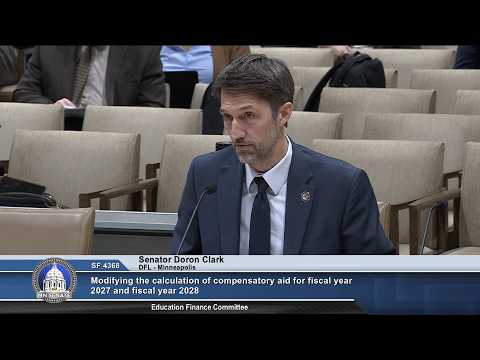
After the presentation, the committee took up Senate File 4368, sponsored by Senator Clark, which would extend a hold‑harmless provision to protect schools from abrupt funding losses while the task force completes its work. Senator Clark moved the A1 amendment (fiscal note), which passed by voice vote. In debate and testimony that followed, superintendents, school board leaders and charter and nonprofit advocates described concrete district losses projected under the direct‑certification‑only approach and urged the one‑year extension.
Christine Petersen, president of the Minnesota School Board Association, said the shift in data collection—not changes in student need—would cause many districts to "face a sudden and drastic revenue loss that does not reflect a change in student needs." Karen Cleansing, executive director of Hiawatha Academies, said her charter serves a high proportion of students eligible for free or reduced‑price meals but only a fraction are captured by direct certification; she warned of annual revenue declines and program cuts.
Fiscal staff walked senators through district‑level tables showing estimated current‑law and proposed amounts; staff said, based on current estimates and the bill as amended, "no district is worse off" under the proposal for fiscal 2027. The committee recommended SF 4368 (as amended) to pass and referred it to the Finance Committee by voice vote.
The Legislature’s work on compensatory revenue is ongoing: the task force will continue to explore proxies and data sources, and MDE said additional analysis on expenditures and correlations with student outcomes will inform final recommendations.