Get Full Government Meeting Transcripts, Videos, & Alerts Forever!
Get email alerts on the Local Sales Tax topic
No spam. Unsubscribe anytime.
Senate Taxes Committee hears a slate of local-option sales-tax and redevelopment proposals; one amendment adopted
Summary
On March 18 the Minnesota Senate Taxes Committee heard municipal and county requests to authorize local-option sales taxes and TIF extensions for projects including arena repairs in Roseau, a Coon Rapids community center, a Forest Lake public works facility, a judicial center proposal, and the Cloquet Area Fire District’s public-safety facility; the panel laid over every bill for further consideration and adopted an A1 amendment on the Albert Lea extension.
ST. PAUL — The Minnesota Senate Taxes Committee on March 18 considered a series of local-option sales-tax and tax-increment financing proposals from cities and counties across the state, with officials describing regional benefits and limited local property-tax capacity as the reason for asking voters to decide. Lawmakers laid over each bill for further work; the committee adopted a technical A1 amendment to the Albert Lea extension during the hearing.
Sen. Andrew Johnson introduced Senate File 3789 on behalf of the City of Roseau, seeking authorization to put a local sales-tax referendum before voters to raise roughly $4.3 million to renovate the historic Roseau Memorial Arena and about $8.2 million to build a 27,000-square-foot community and wellness center. Todd Peterson, who identified himself as a city development coordinator for Roseau, told the committee the arena is listed on the National Register of Historic Places, serves a regional population that includes Manitoba and North Dakota visitors, and needs $4.3 million to replace its ice plant and complete mechanical work to keep the facility operating for future generations.
“Local sales tax is the only equitable way to ensure that the cost of these facilities is shared by those who actually use and benefit from them,” Peterson said, noting the projects are intended to avoid shifting large new costs onto local property owners.
Sen. Tom Hoffman presented Senate File 4269 for the City of Coon Rapids, which would allow the city to ask voters to approve up to a 0.5 percent sales tax to finance renovation and expansion of the police/civic center and construction of a new community center and expanded ice center. The Coon Rapids city manager described the city as a regional retail and activity hub with limited property-wealth capacity to fund large capital projects and said a sales tax helps spread costs across visitors and shoppers who also use those amenities.
Forest Lake Mayor Blake Roberts testified in support of Senate File 4352, a request to authorize up to 0.5 percent in local sales tax to raise about $50 million to construct a modern public works facility the city says is essential to maintain regional roads and services. Roberts told the committee the existing facility predates the current population and is functionally obsolete.
Sen. Dan Jasinski outlined Senate File 4049, which would permit a county referendum for a sales tax of up to 3/8 of one percent to fund a new judicial center and jail (the bill authorizes up to $45 million). County commissioners and a former sheriff said their courthouse, dating to the 19th century, and a 1970 jail no longer meet operational or security needs and that the consolidated facility would centralize courts, corrections, public records and related services.
Sen. Koran presented a 0.25 percent request for Isanti County (Senate File 3788) to finance a regional highway and maintenance facility; county leaders said increased traffic, growth and an aging building necessitate replacement. Chaska city leaders asked for a 10-year extension to TIF District 23 (Senate File 3918) to support City Square West, a mixed-use downtown redevelopment that would include market-rate and 20% income-restricted housing, commercial space and a public plaza; city officials said the district was created in 2020 but certification was delayed until financing and project readiness aligned.
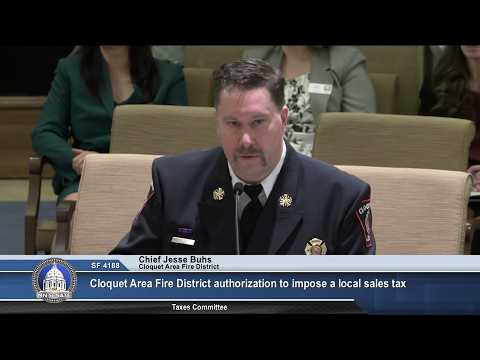
A notable special-district proposal, Senate File 4188, would authorize the Cloquet Area Fire District — a special taxing district that serves two cities and several townships — to pursue a 0.5 percent sales tax. The bill envisions separate city elections (for Cloquet and Scanlon); the fire chief said the tax revenue would be dedicated to bond payments for a combined public-safety facility and that the sales-tax option is preferred over substantially higher property-tax levies.
Sen. Dornink’s amendment package (Senate File 4355) would extend Albert Lea’s existing local sales tax and place separate referendum questions on several projects, including water-quality improvements, trail expansions, library upgrades and recreation projects. The committee adopted an A1 amendment by voice vote during the hearing before laying the bill over.
Smaller local requests included a 0.5 percent sales-tax proposal from Audubon to build a new $3 million fire station (Senate File 4232) and an extension of an existing 0.5 percent food-and-beverage tax in Little Falls (Senate File 4246) that has funded chamber promotional activity for decades.
No final votes on the listed projects occurred; with the exception of the A1 amendment, bills were laid over for further committee work. Committee staff previewed additional local sales-tax bills and a liquor-reporting technical bill for the Department of Revenue in upcoming meetings.
What’s next: Each bill must return to committee for further consideration and any required technical drafting; most local-option sales taxes require separate voter referendums before taking effect. The committee’s next steps were not scheduled during the hearing.
Sources: Testimony and bill walkthroughs before the Minnesota Senate Taxes Committee on March 18, 2026.