Get Full Government Meeting Transcripts, Videos, & Alerts Forever!
Get email alerts on the Heritage Fund topic
No spam. Unsubscribe anytime.
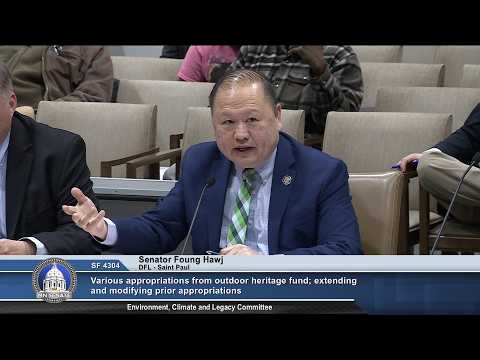
Senate committee advances Outdoor Heritage Fund bill after adopting amendments and removing contested Roseau River project
Summary
The Senate Environment, Climate and Legacy Committee recommended the Outdoor Heritage Fund bill to the Finance Committee after adopting multiple amendments and removing a contested Roseau River project following extensive testimony from landowners, watershed officials and DNR staff about alleged takings, public-notice failures and project benefits.
The Minnesota Senate Environment, Climate and Legacy Committee on March 17 advanced the Outdoor Heritage Fund appropriations bill, adopting an author’s amendment and two floor amendments, and removing a contested Roseau River watershed project after sustained public testimony and questioning.
Christina Smitten, introduced as director of the Outdoor Heritage Council, summarized the council’s 2008 constitutional mandate and the year-long review process that produced the council’s recommendations. She said this year’s recommended appropriations would, if passed, support dozens of projects statewide and produce tens of thousands of acres of protected, restored or enhanced wildlife habitat.
Committee staff and council assistants walked members through the bill’s budget spreadsheet and outputs. They noted two unusually large land-acquisition projects in northeast Minnesota — a roughly $25 million northern forest legacy acquisition (split with St. Louis County and the DNR) and a Sand Lake acquisition led by The Nature Conservancy that together account for most of the bill’s large title-acquisition acreage.
Amendment A6, offered by the author, was adopted to extend a design deadline for a project that the committee discussed as related to Lock and Dam 5; Kelly Pennington, identified as the DNR’s invasive species unit supervisor, told the committee the DNR is under contract with the U.S. Army Corps of Engineers, that design milestones (including a 65% design checkpoint) are in place and that construction is expected in winter 2027–28.
A much longer and more contested section of the hearing focused on a Roseau River watershed project that opponents say will intentionally flood private farmland and has spawned lawsuits. Senator Green offered amendment A7 to remove that project from the bill. Dozens of landowners and coalition representatives — including Debbie Stone of the Minnesota Landowners Coalition and attorney Maxwell Backer — testified that the project would flood up to 12,600 acres of private land, that upstream and downstream impacts had been understated, and that legal challenges alleging unconstitutional takings and statutory violations of the Outdoor Heritage Fund were pending.
Tracy Holston, who identified herself as administrator for the Roseau River Watershed District, and other watershed and DNR witnesses said the project has a decade of development behind it, that the district engaged in public meetings, mediation and technical work, and that much of the project footprint is already public land or was acquired with willing sellers. Holston said construction is partially complete and that modeling to date has not shown widespread backing up of water onto private lands outside the project footprint.
Attorney and landowner testimony alleged statutory limits on spending Outdoor Heritage funds for projects that amount to non-consensual takings, citing the statute referenced in committee testimony (recorded in the hearing as “97 A 0.5 6”). Opponents urged the committee to pause or remove funding for the project until litigation is resolved. Committee members debated whether to preserve the overall integrity of the council’s package while addressing local concerns.
After testimony and senator questions, the committee adopted amendment A7 to remove the contested Roseau River project from the bill by voice vote. The committee then recommended the Outdoor Heritage Fund bill — as amended — to the Finance Committee.
What members said: Senator Green, who moved the A7 amendment, said he supported delaying funding on projects that face active litigation. A number of northern Minnesota members said they were sympathetic to local landowner concerns about property and tax-base impacts; authors and council staff emphasized the competitive review process and oversight mechanisms.
What happens next: The modified Outdoor Heritage Fund bill will go to the Finance Committee for further consideration. Members flagged that some proposed acquisitions are large relative to historical averages and requested additional fiscal and property-tax impact analysis for counties where extensive title acquisitions are proposed.
Note on transcript spellings: Some names and statutory citations in the hearing record were garbled in the transcript; when specific statutory citations are referenced in testimony they were recorded as spoken (see authorities).