Get Full Government Meeting Transcripts, Videos, & Alerts Forever!
Get email alerts on the Contractor Bays topic
No spam. Unsubscribe anytime.
Council declines to approve contractor‑bays special permit at Hardy and Monroe after neighborhood concerns
Summary
After an extended hearing and debate about flood‑zone history, parking, overnight snow storage and noise, the council voted on a motion to approve the Hardy and Monroe special permit with multiple conditions; the transcript records the motion as failing following roll-call votes.
Peabody City Council held a lengthy public hearing and debate over a special permit application from Hardy and Monroe LLC to construct contractor bays (indoor storage/office for contractors, no outdoor storage) at 0 Hardy Street. The applicants presented a site plan reduced to six bays and said they would not allow outdoor storage; the planning board and conservation commission had reviewed the project.
Attorney John Kelty outlined the project and noted an institutional agreement (an AUL) restricting disturbance of contamination, which informed the proposed footprint and construction approach. Applicants David Potter (in person) and Michael Becker (on Zoom) described the intended users as small owner‑operators who need indoor vehicle storage; Potter said many trucks carry their equipment and that the bays are sized for single vehicles and limited materials.
Ward Councilor Peach, who led conditions negotiations with the applicants, presented a package of permit restrictions she said were negotiated with the applicants: reduce to six bays (December 11, 2025 plan), no commercial vehicles using Monroe Street, no outdoor parking, requirement that personal vehicles be stored inside once commercial vehicles are removed, bar auto-repair and detailing tenants, require backing-in at night to reduce early-morning backup-alarm noise, hours of operation set at 6:30 a.m.–8:00 p.m., developer to work with DPS on an ADA sidewalk, secured rollaway dumpster location, adherence to the conservation commission order (Docket 55-936), and compliance with downtown design standards.
Opponents among councilors cited concerns about the site’s FEMA flood‑zone history, how snow would be stored on a small lot, potential difficulty enforcing conditions over time, neighborhood traffic and safety, and the risk of other allowed uses if the special permit were denied. Councilor Turko said he did not believe the use fit the tight residential neighborhood; Councilor Hawkman raised snow-storage and flood-zone safety concerns. Applicant representatives said the building design and placement of landscaping, faux windows and dumpster placement were intended to buffer neighbors and limit impacts.
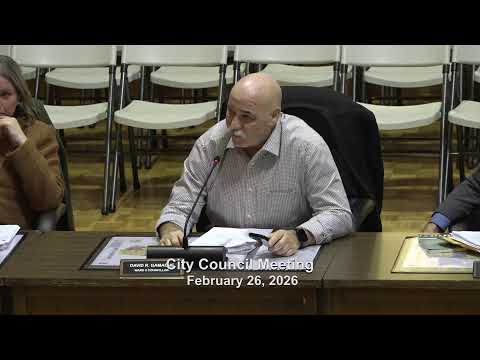
Councilor Peach moved to approve the special permit with the listed conditions. The transcript records a roll-call vote with individual votes recorded and then states, "Motion fails." The recorded roll-call entries list yes and no votes (as recorded in the meeting transcript), and the council did not adopt the permit at this meeting.
Because the transcript records both the roll-call entries and the chairman’s announcement that the motion failed, the council’s next procedural options are to return the item to a committee, amend and refile conditions with the applicant, or bring a new motion at a later meeting; the transcript does not show a follow-up motion before adjournment.