Get Full Government Meeting Transcripts, Videos, & Alerts Forever!
Get email alerts on the Suny Ulster Budget topic
No spam. Unsubscribe anytime.
SUNY Ulster outlines budget pressures as enrollment edges up
Summary
SUNY Ulster officials presented a 2026 budget that holds tuition flat, projects a 1.1% enrollment increase, and attributes most pressure to rising benefits and salary costs; college leaders highlighted a $4.7 million initial deficit and outlined strategies to boost enrollment and examine shared services.
SUNY Ulster officials told Ulster County legislators on May 5 that the college will keep tuition flat for the coming year but faces budgetary pressure driven mainly by rising benefits and salary costs. Michael Schreiber, SUNY Ulster’s Vice President of Administration and Finance, said the budget process began with a $4.7 million deficit and that the college is using an executive summary and pivot‑table analyses to make the multi‑page budget easier to review.
Schreiber said the college is projecting a 1.1% increase in enrollment for the current academic year and is using a conservative 3% projection for next year’s tuition‑revenue plan. He described head‑count versus full‑time‑equivalent (FTE) measures, saying fall FTE was about 950 and that roughly 3,150 individuals were served by the college this year across credit and non‑credit programs.
The presentation placed most of the cost growth in benefits and salaries: Schreiber reported a benefits increase of about $1.1 million (including health‑plan and retirement adjustments) and a salary increase of roughly $461,000, which incorporates contractual settlements across bargaining units and two proposed new full‑time positions (a faculty hire in education/psychology and an administrative aide).
Schreiber also flagged volatile operating costs: heating‑oil assumptions changed dramatically after the budget was drafted (he said the college budgeted $3.87 per gallon but market prices exceeded $5 per gallon), a swing that he estimated could add roughly $102,000 if prices remain elevated. He outlined longer‑term cost‑saving options under study, including shared health‑insurance arrangements with the county and pooled procurement across colleges.
On fund balances and intercounty chargebacks, Schreiber said the college’s audited fund balance stood at $7.9 million as of Aug. 31, 2025. He noted chargeback rate disparities when students enroll outside their home county and that projected increases in Ulster’s out‑of‑county billable rate could generate additional revenue.
In questions that followed, Dr. Buckley and Schreiber said the college is targeting adult learners without postsecondary credentials and investing in retention (evening/weekend sections, transportation) to sustain modest enrollment gains. Legislators pressed college leaders on fiscal realism given county budget constraints; Schreiber and Dr. Buckley acknowledged the county’s role in the college’s three‑leg funding model (county, state, student tuition) and said they were trying to balance long‑term enrollment strategies with near‑term fiscal prudence.
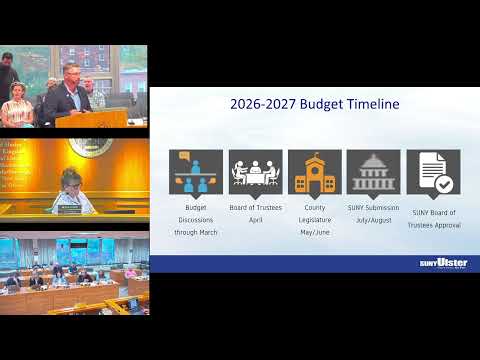
The college will hold a public hearing on the budget this month and expects a vote in June before SUNY submission.